Wednesday, June 18, 2008

Susanna Elm, UC Berkeley


Susanna Elm
Professor of History and Classics


D.Phil. Oxon., Literae Humaniores (Ancient History) St. Hilda's College, 1986
Philosophicum, summa cum laude, Free University Berlin (BA-equivalent in Philosophy and education), 1982
Interim examination, summa cum laude, University Berlin, 1980
Music certificate, qualified flute teacher, North Rhine Westphalian Academy of Music, 1978
Valedictorian, Gymnasium Leopoldinum I, Detmold, 1978

Selected Publications:

Books:

Virgins of God. The Making of Asceticism in Late Antiquity. Oxford Classical Monograph Series. Oxford: Clarendon Press, 1994; Paperback, 1996, re-ed. 1999, 2003).

The "Holy Man" Revisited (1971-1997): Charisma, Texts, and Communities in Late Antiquity. Ed. Susanna Elm and Naomi Janowitz. Special Issue Journal of Early Christian Studies 6: 3 (1998).

Orthodoxie, christianisme, histoire - Orthodoxy, Christianity, History. Ed. Susanna Elm, Éric Rebillard and Antonella Romano. Collection de l'École française de Rome 270. Rome: École française de Rome, 2000.

Medical Challenges for the New Millennium - An Interdisciplinary Task. Ed. Stefan N. Willich and Susanna Elm. New York/Amsterdam: Kluver, 2001.

Violence in Late Antiquity: Perceptions and Practices. Ed. H. Drake and co-ed. E. Albu, S. Elm, M. Maas, C. Rapp, M. Salzman. London: Ashgate, 2006.

Sons of Hellenism, Fathers of the Church: Gregory of Nazianzus, Emperor Julian, and the Christianization of the Late Roman Elites. In preparation.

Quo Vadis - Medical Healing. Past Concepts and New Approaches. Ed. Susanna Elm and Stefan Willich. New York: Springer, forthcoming.

Articles:

"An Alleged Book theft in Fourth Century Egypt: P. Lips. 43." Studia Patristica 18 (1989): 209-215.

"Perceptions of Jerusalem Pilgrimage as Reflected in Two Early Sources on Female Pilgrimage (3rd and 4th Century A.D.)." Studia Patristica 20 (1989): 219-223.

"The Sententiae ad Virginem by Evagrius Ponticus and the Problem of Early Monastic Rules." Augustinianum 30 (1990): 393-404.

"Evagrius Ponticus' Sententiae ad Virginem." Dumbarton Oaks Papers 45 (1991): 265-295.

"Vergini, vedove, diaconisse - alcuni osservazioni sullo sviluppo dei cosidetti "ordini femminile’ nel quarto secolo in Oriente." Codex Aquilarensis 5 (1991): 77-89.

"Formen des Zusammenlebens mät;nnlicher und weiblicher Asketen im östlichen Mittelmeerraum wät;hrend des vierten Jahrhunderts nach Christus," in Doppelklöster und andere Formen der Symbiose mät;nnlicher und weiblicher Religiosen im Mittelalter. Ed. Kaspar Elm and Michel Parisse. Berliner Historische Studien 18; Ordensstudien 8. Berlin: Duncker and Humblot, 1992, 13-24.

"Athanasius of Alexandria’s Letter to the Virgins - who was its intended audience?" in Ricerche Patristiche in onore di Dom Basil Studer OSB. Ed. V. Grossi and A. di Berardino. Augustianum 33. Rome: Institutum Patristicum Augustianum, 1993, 171-183.

"Priests ... shall not make any cuttings in their flesh (Lev. 21: 5)." Graven Images 2 (1995): 36-41.

"Schon auf Erden Engel:" Einige Berkungen zu den Anfät;ngen asketischer Gemeinschaften in Kleinasien." Historia 45 (1996): 483-500.

"The Polemical Use of Genealogies: Jerome's Classification of Pelagius and Evagrius Ponticus" Studia Patristica 33 (1996): 311-318.

"Pierced by Bronze Needles:" Anti-Montanist Charges of Ritual Stigmatization in their Fourth-Century Context." Journal of Early Christian Studies (Special Issue) 4: 4 (1996): 409-439.

"Isis' Loss: Gender, Dependence, and Ethnicity in Synesius' De Providentia or Egyptian Tale." in Journal of Ancient Christianity 1 (1997): 96-115.

"Der Asket als vir publicus. Die Bedeutung von Augustinus' Konzept des Christus iustus et iustificans für den spät;tantiken Asketen als Bischof," in: Recht, Macht, Gerechtigkeit. Ed. J. Mehlhausen. Veröffentlichungen der Wissenschaflichen Gesellschaft für Theologie. Gütersloh: Kaiser, 1999, 192-201.

"The Dog that Did Not Bark: Doctrine and Patriarchal Authority in the Conflict between Theophilus of Alexandria and John Chrysostom of Constantinople," in: Christian Origins I. Ed. L. Ayres and G. Jones. London: Routledge, 1998, 68-93.

"The Diagnostic Gaze: Gregory of Nazianzus' Theory of Orthodox Priesthood in his Oration 6 "De pace" and 2 "Apologia de Fuga sua," in:Orthodoxie, christianisme, histoire/ Orthodoxy, Christianity, History. Ed. Susanna Elm, Éric Rebillard and Antonella Romano. Rome: École française de Rome, 2000, 83-100.

"Inventing the Father of the Church: Gregory of Nazianzus' "Farewell to the Bishops" (Or. 42) in its Historical Context," in Vita Religiosa im Mittelalter. Ed. Franz Felten and Norbert Jaspert. Berlin: Dunker und Humblot, 1999, 3-20.

" 'Sklave Gottes' – Stigmata, Bischöfe und anti-hät;retische Propaganda im vierten Jahrhundert." Historische Anthropologie 8: 3 (1999): 345-363.

"A Programmatic Life: Gregory of Nazianzus’ Orations 42 and 43 and the Constantinopolitan Elites." Arethusa 33 (2000): 411-427.

"Orthodoxy and the True Philosophical Life: Julian and Gregory of Nazianzus." Studia Patristica 37 (2001): 69-85.

"Developments in Ancient Medicine - Models for Today's Challenges? Contemporary Medicine and the Christianisation of the Roman Elite – a Parallel," in Medical Challenges for the New Millenium - An Interdisciplinary Task. Ed. Stefan N. Willich and Susanna Elm. New York/Amsterdam: Kluver, 2001, 3-17.

"Historiographic Identities. Julian, Gregory of Nazianzus and the Forging of Orthodoxy," JAC/ZAC 7 (2003): 249-266.

"Inscriptions and Conversions. Gregory of Nazianzus on Baptism (or. 38-40)," in Conversion in Late Antiquity and the Early Middle Ages: Seeing and Believing. Ed. Kenneth Mills and Anthony Grafton. Rochester: University of Rochester Press, 2003, 1-35.

"Hellenism and Historiography: Gregory of Nazianzus and Julian in Dialogue," Journal of Early Medieval Europe 33: 3, Special issue honoring Elizabeth A. Clark, 2003, 493-515; Italian version, “Ellenismo e Storiografia. Giuliano emperore e Gregorio Nazianzeno," in Societá e cultura nella tarda antichitá, Ed. A. Marcone. Florence: Le Monier, 2004, 58-76.

"Marking the Self in Late Antiquity: Inscriptions, Baptism and the Conversion of Mimes," in: Stigmata. Ed. Bettine Menken and Barbara Vinken. Paderborn: Wilhelm Fink Verlag, 2004, 47-68.

"A response," Reconsiderations. Augustine and his Time. Ed. W. Fitzgerald. Villanova University Press, 2005, 16-21.

" 'Oh Paradoxical Fusion:' Gregory of Nazianzus on Baptism and Cosmology (Or. 38-40)," in: Heavenly Realms and Earthly Realities in Late Antique Religions. Ed. R. A. Boustan and A. Y. Reed. Cambridge: Cambridge University Press, 2004, 617-657.

"Gregory's Women: Creating a Philosopher’s Family," in Gregory of Nazianzus: Images and Reflections. Ed. Jostein Břrtnes and Tomas Hät;gg. Oslo: Oslo University Press, 2006, 171-191.

"Captive Crowds: Pilgrims and Martyrs," in CROWDS. Ed. Jeffrey T. Schnapp and M. Tiews, Palo Alto: Stanford University Press, 2006, 133-148.

"Roman Pain and the Rise of Christianity," in Quo Vadis Medical Healing: Past Concepts and New Approaches. Ed. Susanna Elm and Stefan Willich. New York: Springer, forthcoming.

"Perpetua the Martyr – Perpetua the Saint. The Cultural Context of an Early Christian Phenomenon," In: The Imagined Worlds of Martyrdom. Ed. Christopher Ocker and Susanna Elm. Submitted to Cambridge Press.

"Family Men. Masculinity and Philosophy in Late Antiquity," Festschrift Peter Brown. Ed. Philip Rousseau, forthcoming.

Recent Invited Lectures:

Schloss Elmau: Interdisciplinary Conference on Medicine; Healing, Quo vadis?: "Roman Pain and the Rise of Christianity” (5/4-7/03).

Udine: Universitá di Udine, Societá e Cultura in eta tardoantica: “Ellenismo e Storiografia.” (5/29-30/03).

Oslo: Norwegian Institute of Advanced Studies, Oslo: Colloquium Gregory of Nazianzus:
“Gregory's Women” (6/16/03).

Tokyo: Keio University, Dept. of History: “Wandering Bishops” (10/6/03).
Villanova: Institute for Augustinian Studies: Saint Augustine-Reconsiderations: Comment (12/6/03).

Bielefeld: Dept. of History: “Becoming Roman in Rom: Malaria und Migration” (2/7/04).
St. Louis: Dept. of History, Washington University: “Both Mother and Father: Gregory of Nazianzus’ Philosophical Family and the Question of Masculinity in Late Antiquity”
(4/6/04).

Miami: University of Miami, Dept. of History: “Gregory’s Women” (4/15/04).
Stanford: Humanities Center: “A New Masculinity in Late Antiquity?” (5/17/04).
Princeton: IAS, “Prophecy and Divine Ascent” – The Late Antique Roots of the Koran
Colloquium (6/2-4/04).

Kiel: Dept. of History: ““Both Mother and Father: Gregory of Nazianzus’ Philosophical Family and the Question of Masculinity in Late Antiquity” (06/25/04).

Washington DC: Dept. of Classics, The Andrew Mellon Lecture: “Romanitas: Slavery,
Demography and Roman Identity.” (10/29/04).

Princeton: Dept. of History, Shelby Collum Davis Center Thirty Year Anniversary: “Why I do the History I do” (11/18/04).

Vancouver: Dept. of English, Center for Medieval Studies, Conference Performing the Past: “History and Histrionics” (10/28-10/29/06).

Berlin: American Academy, Ellen Maria Gorrison Lecture: “Pagan Challenge - Christian
Response - Transforming the Late Antique Elites” (02/06/07).

Frankfurt a. M.: Max-Planck Institut für Rechtsgeschichte: “Divine Decree and Imperial Enactment” (05/03/07).


Contact

Office: 2310 Dwinelle Hall
Hours: Tuesday 2-4pm
Phone: (510) 642-2238
Email: elm@berkeley.edu

Professor David Mattingly


Professor of Roman Archaeology, University of Leicester, BA PhD FBA FSA

Following a BA in History at the University of Manchester, he completed a PhD under the supervision of Professor Barri Jones at the same University.


He was a British Academy Post-doctoral fellow at the Institute of Archaeology, Oxford (1986-1989), then Assistant Professor at the University of Michigan before coming to Leicester in December 1991 as a Lecturer. He was promoted to Reader (1995) and Professor (1998).

Heheld a British Academy Research Readership award from 1999-2001 and was elected Fellow of the British Academy in 2003.


Current Research Interests and Projects

His research has been wide-ranging in chronological and geographical terms, as well as in subject matter. There are strong unifying trends running through and he is essentially a specialist in the archaeology of the Roman empire. He is an active field archaeologist and has organised projects in Britain, Italy, Libya, Tunisia and Jordan.

A significant component throughout his career to date has been the study of Roman Africa. His main contributions to the advancement of Roman Africa studies have been in terms of study of rural settlement, farming technology and the economy; urbanism and the urban economy; post-colonial approaches to the impact of Rome; the evolution of the Roman military frontiers and, latterly, the study of native society beyond those frontiers. He was a major author of the final reports on the UNESCO Libyan Valleys Survey, and helped initiate work in 1990 at an important Tunisian harbour site called Leptiminus, leading to two published volume of reports, with a third co-edited volume in progress. Recently, the Fazzan Project in Libya has taken him beyond the boundaries of the Roman empire to research the Saharan heartlands of an important people called the Garamantes. This Sahara work has now entered a new phase as the Desert Migration Project.

A second research strand developed from his Oxford-based post-doctoral research into olive cultivation in the Roman world and the production of olive oil and its trade.

A third area of research has been rural field survey, where he has published final reports on multi-period work near Rieti in Italy and in Libya, whilst a monograph on co-directed work in Jordan (Wadi Faynan) is in an advanced state of preparation. Other areas of interest include Roman Britain, imperialism in the Roman world, Roman economic and social history and cartography of the ancient world.

He has authored, co-authored, edited or co-edited 18 monographs. Several others are in preparation. In addition he has written (or contributed to) 140 published articles/chapters, 8 review articles and about 150 other book reviews or minor works.

Recent Publications

  • (with G. Barker and D. Gilbertson et al.) Archaeology and Desertification: the Wadi Faynan Landscape Survey, southern Jordan. Oxbow, CBRL, Oxford (in press).
  • (with C.M. Daniels, J.N. Dore, D. Edwards and J. Hawthorne). The Archaeology of Fazzan. Volume 2, Site Gazetteer, Pottery and Other Survey Finds. London (2007). Pp xxx and 522. (edited by D. Mattingly).
  • (edited with G. Shipley, J. Vanderspoel and L. Foxhall,). The Cambridge Dictionary of Classical Civilization. Cambridge University Press, Cambridge (2006). Pp. xliv and 966.
  • An Imperial Possession. Britain in the Roman Empire. Penguin History of Britain Series. London (2006). Pp. xvi and 622. (Paperback edition 2007 with minor corrections).
  • (edited with S. McLaren, E. Savage, Y al-Fasatwi and K. Gadgood). The Libyan Desert: Natural Resources and Cultural Heritage. Society for Libyan Studies, London (2006). Pp. x and 338.
  • (with C.M. Daniels, J.N. Dore, D. Edwards and J. Hawthorne) The Archaeology of Fazzan: Volume 1 (Synthesis, London, 2003), pp. xxvi and 430, 460 figures (edited by D. Mattingly).
  • (with L. Stirling and N. Ben Lazreg). Leptiminus (Lamta): Report no. 2, The East Baths, Cemeteries, Kilns, Venus Mosaic, Site Museum and other studies Portsmouth, RI, JRA Suppl. 40. (2001), pp. 464. See also (with N. Ben Lazreg and contributions from others). Leptiminus (Lamta): a Roman port city in Tunisia, Report no. 1. Ann Arbor (1992), pp. 333
  • (edited with J. Salmon). Economies beyond Agriculture in the Classical World. (Leicester Nottingham Ancient History Seminar Series, Routledge. (2001 [2000]), pp. xii and 324
  • (edited with D. Potter). Life, Death and Entertainment in Ancient Rome. (Ann Arbor, University of Michigan Press). (1999), pp. xiv and 353
  • (edited). Dialogues in Roman Imperialism. Power, Discourse and Discrepant Experience in the Roman Empire (Journal of Roman Archaeology, Suppl. vol 23), Portsmouth, RI (1997), pp. 200
  • (with G.W.W. Barker, D.D. Gilbertson and G.D.B. Jones). Farming the Desert The UNESCO Libyan Valleys Archaeological Survey. Volume 1, Synthesis. (principal editor, G. Barker), UNESCO, Soc. for Libyan Studies, Paris/London (1996), pp. xx and 404; Volume 2, Gazetteer and Pottery (principal editor, D.J. Mattingly), UNESCO, Soc. for Libyan Studies, Paris/London (1996), pp. xxii and 394
  • Tripolitania. Batsford, London (1995), pp. xxii and 266

Contact Details:

Friday, May 02, 2008

Jon E. Lendon


Jon E. Lendon

Corcoran Department of History

The University of Virginia

Randall Hall

P.O. Box 400180

Charlottesville, Virginia 22904-4180

lendon@virginia.edu


Education:

1991 Ph.D. Yale University, History.

1986 B.A. Yale University, History and Classical

Civilization, summa cum laude, Phi Beta

Kappa, with distinction in both majors.


A. Books:

Soldiers and Ghosts: A History of Battle in Classical Antiquity (New Haven and London: Yale University Press, 2005).

Empire of Honour: The Art of Government in the Roman World (Oxford: Clarendon Press, 1997).

B. Articles:

"War and Society in the Hellenistic World and the Roman Republic," forthcoming in H. van Wees, P. Sabin, and M. Whitby (eds.), Cambridge History of Greek and Roman Warfare (Cambridge: Cambridge University Pr.).

"Cavalry Formations in the Greek Tactical Tradition," forthcoming in N. V. Sekunda (ed.), Acts of the First International Conference on Hellenistic Warfare.

"Athens and Sparta and the Coming of the Peloponnesian War," in L. J. Samons (ed.), Cambridge Companion to the Age of Pericles (New York: Cambridge University Pr., 2007) pp. 258-281.

"The Legitimacy of the Roman Emperor: Against Weberian Legitimacy and Imperial 'Strategies of Legitimation'" in A. Kolb (ed.), Herrschaftsstrukturen und Herrschaftspraxis (Akademie: Berlin, 2006) pp. 53-63.

"Xenophon and the Alternative to Realist Foreign Policy: Cyropaedia 3.1.14-31," Journal of Hellenic Studies 126 (2006) pp. 82-98.

"Contubernalis, Commanipularis, and Commilito in Roman Soldiers' Epigraphy: Drawing the Distinction," Zeitschrift für Papyrologie und Epigraphik 157 (2006) pp. 270-276.

"Historical Thought in Ancient Rome," in L. Kramer and S. Maza (eds.), A Companion to Western Historical Thought (Oxford: Blackwell, 2002) pp. 60-77.

"Voting by Shouting in Sparta," in E. Tylawsky and C. Weiss (eds.), Essays in Honor of Gordon Williams: Twenty- Five Years at Yale (New Haven: Henry R. Schwab, 2001) pp. 169-75.

"Homeric Vengeance and the Outbreak of Greek Wars," in H. van Wees (ed.), War and Violence in Ancient Greece (London: Duckworth/Classical Press of Wales, 2000) pp. 1-30.

"The Rhetoric of Combat: Greek Theory and Roman Culture in Julius Caesar's Battle Descriptions," Classical Antiquity 18 (1999) pp. 273-329.

"Spartan Honor," in C. Hamilton and P. Krentz (eds.), Polis and Polemos: Essays on Politics, War, and History in Ancient Greece, in Honor of Donald Kagan (Claremont, California: Regina Books, 1997) pp. 105-26.

"Thucydides and the 'Constitution' of the Peloponnesian League," Greek, Roman, and Byzantine Studies 35 (1994) pp. 159-77.

"The Face on the Coins and Inflation in Roman Egypt,"
Klio 72 (1990) pp. 106-34.

"The Oxyrhynchus Historian and the Origins of the
Corinthian War," Historia 38 (1989) pp. 300-13.

C. Review articles and academic book reviews:

"Greek Art and Culture Since Art and Experience in Classical Greece" (review article) with E. A. Meyer, in J. M. Barringer and J. M. Hurwit (eds.), Periklean Athens and its Legacy (Austin: University of Texas Press, 2005) pp. 255-276.

Review of C. R. Whittaker, Rome and its Frontiers: The Dynamics of Empire (London/New York: Routledge, 2004)and T. S. Burns, Rome and the Barbarians, 100 B.C.-A.D. 400 (Baltimore and London: Johns Hopkins University Press, 2003), The Journal of Roman Studies 95 (2005) pp. 257-9.

Review of A. K. Bowman, H. M. Cotton, M. Goodman, and S. Price (eds.), Representations of Empire: Rome and the Mediterranean World in The Classical Review 54(2004) pp. 483-5.

"The Ignorance Factory" (review article), Arion 12 (2004) pp. 189-200.

"The Roman Army Now" (review article), The Classical Journal 99 (2004) pp. 441-9.

Review of J. P. Arnason and P. Murphy (eds.), Agon, Logos, Polis: The Greek Achievement and its Aftermath in The Classical Review 52 (2002) pp. 400-401.

"Primitivism and Ancient Foreign Relations" (review article), The Classical Journal 97 (2002) pp. 375-84.

"Gladiators" (review article), The Classical Journal 95 (2000) pp. 399-406.

Review of G. Anderson, Sage, Saint, and Sophist. Holy Men and their Associates in the Early Roman Empire in The International Journal of the Classical Tradition 5 (1998) pp. 114-6.

"Three Emperors and the Roman Imperial Regime" (review article), The Classical Journal 94 (1998) pp. 87-93.

"Social Control at Rome" (review article), The Classical Journal 93 (1997) pp. 83-8.

Review of P. Brown, Power and Persuasion in Late Antiquity: Towards a Christian Empire, in Speculum 69 (1994) pp. 1129-31.


Saturday, April 26, 2008

Robert Garland


Robert Garland
Colgate University
M.A., McMaster University Ph.D., University College London

Robert S.J. Garland, the Roy D. and Margaret B. Wooster Professor of the Classics at Colgate University, is Director of the Division of the Humanities there and has served 13 years as Chair of the Department of the Classics. He earned his B.A. in Classics from Manchester University, his M.A. in Classics from McMaster University, and his Ph.D. in Ancient History from University College London.

A former Fulbright Scholar and recipient of the George Grote Ancient History Prize, Professor Garland has educated students and audiences at a variety of levels. In addition to his 17 years teaching Classics at Colgate University, he has taught English and Drama to secondary school students and lectured at universities throughout Britain as well as the British School of Archaeology in Athens.

Professor Garland is the author of numerous articles in both academic and popular journals and books capturing details of all aspects of ancient Greek and Roman life, including The Greek Way of Life: From Conception to Old Age; Introducing New Gods: The Politics of Athenian Religion; and Daily Life of the Ancient Greeks. His expertise has been featured in The History Channel's "Last Stand of the 300," and he has repeatedly served as a consultant for educational film companies.

I also noticed that he wrote, "The Eye of the Beholder: Deformity and Disability in the Graeco-Roman World", a "detailed investigation of the plight of those Greeks and Romans who, owing either to deformity or to disability, did not meet their society's exacting criteria for the ideal human form. Drawing on classical drama and poetry, historical works, medical tracts, vase painting and sculpture, mythology, and ethnography, Garland examines the high incidence of disability and deformity among the Greek and Roman population."

This subject really interests me. Recently, I viewed an exhibition of Roman art from the Louvre up at the Seattle Art Museum and was surprised by a reference to Caligula being somewhat deformed since I had never read that before. According to the Louvre, apparently most sculptures of Caligula are idealized and purposefully sculpted to emphasize his relationship to Augustus. The reason I find the idea of a deformed Caligula as somewhat incredulous is that he was adored as a child by the legions and Roman society was not terribly forgiving about physical shortcomings even in childhood - especially if you consider the treatment of Claudius

Friday, February 01, 2008

Michele R. Salzman, University of California at Riverside


Professor of History

College of Humanities, Arts, and Social Sciences
History

Degrees

B.A. Latin 1973
Brooklyn College of the City University of New York
M.A. Latin 1975
Bryn Mawr College
Ph.D. Latin & Greek 1981
Bryn Mawr College

Awards

Professor-in-Charge, Intercollegiate Center for Classical Studies in Rome (administered by Duke University), 2003-2004.
Member of the Editorial Board, American Journal of Archaeology, 2004-2007
Organizer, Penates, and Steering Board of Multi-Campus Research Group for the Study of Late Antiquity in Southern California, 1998-present
American Council of Learned Societies Travel Grant, 1990
Mellon Fellow in Classical Studies, American Academy in Rome, 1986-87
ACLS Research Fellowship, 1983

Research Area

Ancient Greece & Rome; late antiquity; social and religious history

Publications

On Roman Time: The Codex-Calendar of 354 and the Rhythms of Urban Life in Late Antiquity.

"Because they list all the public holidays and pagan festivals of the age, calendars provide unique insights into the culture and everyday life of ancient Rome. The Codex-Calendar of 354 miraculously survived the Fall of Rome. Although it was subsequently lost, the copies made in the Renaissance remain invaluable documents of Roman society and religion in the years between Constantine's conversion and the fall of the Western Empire.

In this richly illustrated book, Michele Renee Salzman establishes that the traditions of Roman art and literature were still very much alive in the mid-fourth century. Going beyond this analysis of precedents and genre, Salzman also studies the Calendar of 354 as a reflection of the world that produced and used it. Her work reveals the continuing importance of pagan festivals and cults in the Christian era and highlights the rise of a respectable aristocratic Christianity that combined pagan and Christian practices. Salzman stresses the key role of the Christian emperors and imperial institutions in supporting pagan rituals. Such policies of accomodation and assimilation resulted in a gradual and relatively peaceful transformation of Rome from a pagan to a Christian capital. "

Berkeley: University of California Press, 1990.
The Making of a Christian Aristocracy. Cambridge, MA: Harvard University Press, 2002.

"Christian Century : This fascinating and important book...discusses the social origins and career paths of the aristocratic men--and the family involvements of the women--who converted to Christianity, and concludes by exploring 'the emperor's influence on aristocratic conversion' and 'the aristocrats' influence on Christianity'...Salzman's work is important not just for the study of the early church but for the study of the whole history of Christianity. The class distinctions which she so ably explores were significant not only for early Christians, but also for the medieval church and the Reformation church."
--Robert M. Grant

Former Institution

Boston University

Biography

Michele Salzman received her B.A. in Latin (1973) from Brooklyn College of City University of New York and her M.A. (1975) and Ph.D. (1981) from Bryn Mawr College in Greek and Latin. Before joining the faculty at the University of California, Riverside in 1995, she taught at Swarthmore College, Columbia University, and, for thirteen years, at Boston University. Salzman's research focuses on the religious and social history of Late Antiquity. She is author of Roman Time: The Codex-Calendar of 354 and the Rhythms of Urban Life in Late Antiquity (UC Press, 1990), as well as several articles on Roman history and religion. Her new book, The Making of a Christian Aristocracy (Harvard University Press) examined the social and religious issues that bear upon the conversion of the Roman aristocracy from paganism to Christianity in the Roman Empire in the West in the years after Constantine. Salzman is currently interested engaged in a commentary and translation of Book 1 of the Letters of the late Roman senator Symmachus. Salzman was Mellon Fellow in Classical Studies at the American Academy in Rome, 1986-87. In addition, she has received research fellowships from the American Council of Learned Societies, the American Philosophical Society, and the Whiting Foundation. In 2003-2004 she was professor in charge of the Intercollegiate Center for Classical Studies in Rome. She is currently on the editorial Board of the American Journal of Archaeology. She is one of the members of the Steering Committee for the Multi-Campus Research Group for Late Antiquity.

Contact information:

michele.salzman@ucr.edu

HMNSS Bldg. 6603
University of California
Riverside, CA 92521


(951) 827-1991 (Voice)
(951) 827-5299 (Fax)
(951) 827-5401 (Dept)

Monday, December 24, 2007

Thomas McGinn


Thomas A.J. McGinn
2933 Polo Club Road
Nashville, TN 37221-4346

(615) 371-5245 (tel.)
(615) 371-1301 (fax)

thomas.a.mcginn@vanderbilt.edu
tommcginn@comcast.net

Harvard College B.A. magna cum laude 1978
Cambridge University M.A. 1980
University of Michigan Ph.D. 1986

Title of Dissertation: Prostitution and Julio-Claudian Legislation: The Formation of
Social Policy in Early Imperial Rome

Special Areas of Interest: Roman Law and Social History

Recent Publications:

Books:
1. Prostitution, Sexuality, and the Law in Ancient Rome (Oxford University Press: 1998)
Paperback edition published by Oxford University Press in January 2003

2. A Casebook on Roman Family Law (coauthor with Bruce Frier: Oxford University Press: October 2003)

3. The Economy of Prostitution in the Roman World: A Study of Social History and the Brothel (University of Michigan Press: February 2004)

Recent articles and/or chapters:

Historia: Zeitschrift für alte Geschichte 53.2 ( 2004) 200-208: Missing Females?: Augustus’ Encouragement of Marriage Between Freeborn Males and Freedwomen

in J.-J. Aubert and A.J.B. Sirks eds., Speculum Iuris: Roman Law as a Reflection of
Economic and Social Life (University of Michigan Press 2002) 46-93: The Augustan
Marriage Legislation and Social Practice: Elite Endogamy vs. Male “Marrying Down”

Proceedings of the Cambridge Philological Society 47 (2001) 81-102: Satire and the Law:
The Case of Horace

Abstract from work review:

"As an example selected very nearly at random, consider Case 8, "The ability to procreate" (29-30). Citing Justinian's Digest (D. 23.3.39.1, Ulpian in the thirty-third book on the Edict), the case examines whether a woman can validly marry a eunuch (spado, more generally a sterile or impotent male, as the authors point out on p. 363) and whether the latter may therefore receive a dowry. Ulpian distinguishes those whose infertility has been caused by castration, on one hand, from those whose condition results from unspecified (presumably natural) causes, on the other. The former cannot marry, concludes the jurist without further elaboration, but the latter can.

Ulpian's reasoning in this instance is elusive, to say the least. F/M describe the distinction as "odd," but point out that it is operative in other instances as well. Apparently there is some stigma attaching to castration, and not to infertility in general, that raises a bar to marriage. F/M ask: is Ulpian's objection founded upon morality? "Does Ulpian presume that the eunuch's castration was deliberate, not accidental? And if deliberate, who bears the blame?"

My own experiences in discussing this and comparable material with undergraduates suggest that the topic of deliberate castration in antiquity offers fodder for wide-ranging, if not always well-focused, discussions about cultural difference. F/M direct their reader instead to a topic of great cross-cultural interest and considerable contemporary political, legal, and social topicality: "in the Roman world, as in many other past and present societies, a strong tradition linked marriage to the procreation of children[...]. Nonetheless, as this Case shows, inability to beget children was not in itself necessarily a bar to marriage." To what extent does this concession undermine constructions of "traditional" marriages and families? Granting that the sources cannot definitively answer the question one way or other, F/M invite their reader to consider how a proposal to recognize same-sex marriage might fare in the hands of the Roman jurists: "are Roman policies linking marriage and procreation enough to make same-sex marriage impossible?"

While the approach of the cases as a whole in the volume is less hypothetical and speculative than this single instance might suggest, this case does illustrate the extent to which volume as a whole is conceived as an introduction to, and an exercise in, legal reasoning in general as well as Roman family law in particular. The authors suggest that to encounter this law is to encounter social and historical difference in a manner that challenges "the tacit presumptions of modern family life" and problematizes the claim of any particular family formation to be "authentically 'traditional,'" and they note the extent to which family relationships and the claims of nontraditional families have become subject to legal scrutiny in recent decades (3). At the same time, the reader is warned that the juristic sources "must always be appreciated as a set of primarily legal institutions, not as an anthropological description of actual Roman family life" (11) and that they concern themselves largely with the needs and interests of a landed elite (6)." - Bryn Mawr Classical Review 2005.04.32

Saturday, December 22, 2007

Marc Domingo Gygax, Princeton University


Marc Domingo Gygax,
Associate Professor,
Princeton University

Contact: Phone: 609-258-1084
Email: mdomingo@princeton.edu
Office: 163 East Pyne

Current Courses: CLA219 The Roman Empire (Precepting)
FRS103 Truth and Objectivity in Ancient and Modern Historiography

Background: Lic. Barcelona ’88, M.A. Tübingen ’90, Ph.D. Barcelona ’93.

Professor Domingo Gygax has taught and written mainly in the areas of Hellenistic history, Greek epigraphy, modern historiography and historical theory. He is the author of Untersuchungen zu den lykischen Gemeinwesen in klassischer und hellenistischer Zeit (2001), and currently he is working on a study of the origins and evolution of Greek euergetism.

Work abstract: "A passage of Plutarch’s biography of Alcibiades (Alc. 33.2) invites us to explore the way Athens rewarded its benefactors in the fifth and fourth century, especially the first awards of crowns to citizens. This article challenges the widespread assumption that Alcibiades’ crowning with gold when he came back to Athens from his exile is an invention by Plutarch or a previous source. First, there is evidence that the crowning was known to other ancient authors. Furthermore, if one takes into consideration not only inscriptions, but also literary sources, Plutarch’s report is not an isolated piece of information. It fits well in the history of the Athenian practice of bestowing honors. It has precedents in Athens, continuity after Alcibiades, parallels in other cities, and corresponds to the behavior one would expect from the dêmos as well as from a benefactor at the end of the fifth century. When viewed in this light, Plutarch’s information may help us to understand the first stages of the institution of honoring fellow citizens, which was to become so important in later times." - Plutarch on Alcibiades’ return to Athens, Springerlink.

Tuesday, October 02, 2007

Patrick Hunt, Stanford University

Archaeologist, artist, poet, musician...the talents of Dr. Patrick Hunt of Stanford University seem boundless and he has applied those talents in a variety of arenas as he strives to share his passion about Rome and the ancient world with people worldwide through his research, his writings, his participation in educational broadcasts, his tours, his illustrations, and his musical compositions.

Current Research:

"Dr. Hunt has directed Stanford’s Alpine Archaeology Project since 1994, conducting high altitude research in the Great St. Bernard pass between Switzerland and Italy. In 1996 he found the 9000 ft. high quarry for the Temple of Jupiter in the Fenetre de Ferret pass adjacent to the Great St. Bernard Pass and has directed a team that found a Roman silver coin hoard in the Swiss Alps in 2003. Another of his research interests has been to track Hannibal who crossed the Alps in 218 BCE with an army accompanied by elephants. He has led annual teams across at least ten Alpine passes in search of topographic clues matching the texts of Polybius and Livy who wrote about Hannibal nearly two millennia ago, including multiple Stanford teams between 1996 and 2006.

Three of Dr. Hunt's lectures about Hannibal can be downloaded from Stanford's iTunes U directory.

He has lived in London, Athens and Jerusalem as well as annual time spent in Switzerland, France, Italy every year since 1994, among many other countries, and has also conducted archaeological research in Peru on Inca sites and on Olmec, Maya and Aztec cultures in Central America.

Dr. Hunt has been published on such diverse topics as monuments like the Pantheon, ancient notables such as Gyges from Herodotus, linguistics, biblical studies, the origin of Byzantine Silk, studies in Hebrew poetry and literary wordplay, Roman monuments in operas, calendrical megaliths, Olmec and Maya sculpture, iconography on Greek vases and myth palindromes, nautical exploration, art history, Egyptian stone working and Phoenician lore and geoarchaeology among many other topics.

His academic publications include many journal and encyclopedia entries in peer-reviewed articles such as WORLD ARCHAEOLOGY (1989), BULLETIN OF THE INSTITUTE OF CLASSICAL STUDIES (1988), PAPERS OF THE INSTITUTE OF ARCHAEOLOGY, LONDON (1990), STUDIA PHOENICIA (1991), BEITRAGE FUR ERFORSCHUNG DES ALTEN TESTAMENTS (1992 & 1996), JOURNAL OF ROMAN ARCHAEOLOGY (1998), VOLCANOES, EARTHQUAKES AND ARCHAEOLOGY published by the Royal Geological Society (2000), ACTA of the XIIIth International Bronze Congress at Harvard University (2003), ENCYCLOPEDIA OF THE ANCIENT WORLD (2003) and GREAT EVENTS IN WORLD HISTORY (2004). He has been a Fellow of the Royal Geographical Society since 1989, named in WHO'S WHO IN BIBLICAL STUDIES AND ARCHAEOLOGY (1993) and he has also served as President of the Archaeological Institute of America’s Stanford Society since 1995. Patrick's primary archaeology book of 2007 is titled ALPINE ARCHAEOLOGY." -- Patrick Hunt.net

Many of Dr. Hunt's articles are featured on the website, "Philolog: Classical connections - commentary and critique", a rich resource for art historians, students and all lovers of classical art. His articles including "Arborisms in Ovid's Baucis and Philemon from Metamorphoses" are cited by the Cambridge School Classics Project in their efforts to promote classical studies. An excerpt:

"Perhaps to intensify the transformation of the two old people whose theoxeny - hospitality to their anonymous divine guests (Jupiter and Mercury) - is unique, Ovid fashions and foreshadows their future nature as trees by filling his poetic text with at least 30 references to wood or forest plants. This is a brief catalog of Ovid's passage with possible arboreal interpretations and allusions.

First, Ovid has his narrator (Lelex) tell about what he has seen growing side by side in the Phrygian hills, long after the transformation in their anonymous almost endless life as the yet-unnamed Baucis and Philemon are an oak (quercus) and linden (tilia) tree intertwined (tiliae contermina quercus 8.620).

Second, Philemon welcomes the gods to enter the poor couple’s forest hovel – whose roof is reeds and stalks of straw (stipulis et canna 8.630) - by way of a [wooden] gabled doorpost (vertice postes 8.638) (1). Baucis pulls off dry twigs and stems (ramaliaque arida 8.644) from the thatched roof as tinder for the meal’s fire. Then, using a forked stick (furca…bicornis 8.646) Philemon unhooks dried meat from a blackened wooden beam (nigro…tigno 8.648) and also unfastens a beech wood tub (alveus…fagineus 8.652-3) tub for bathing limbs.(2) Baucis sets up a couch of willow (salignus 8.656) and a wooden table for the fare. The mattress for the gods’ couch is also of soft sedge plants (molli…ulva 8.655). On the one hand, Ovid is accentuating their poverty, as Due mentioned - "praise of the poor but honest simplicity"(3) - so that all their furniture, old and battered, and all household accoutrements mentioned are of wood, hardly surprising given their meager resources, but the wood references are unnecessarily ubiquitous unless Ovid is creating an extended metaphor... More.

Dr. Hunt has been featured on The History Channel in one of my favorite series, "Engineering An Empire: Carthage" and "Engineering an Empire: "The Persians". His research on Hannibal's passage through the Alps will be featured in an upcoming program on The National Geographic Channel.

As a musician and composer, he has been awarded the ASCAPlus Award for Classical and concert music composed and performed in both 2007 and 2008, including several premiere arias from his opera BYRON IN GREECE.

Among many classical music works, he has written piano, choral and chamber music and is a Full Writer member of ASCAP since 1980 when some of his choral songs were published along with a movie score he composed. In 1999, a Duke University musical group performed his SONGS OF EXILE: By the Rivers of Babylon in Washington, DC, Raleigh and at Duke. He also set William Blake poems to choral music that was performed at Stanford in February, 2005.

"Dr. Hunt illustrated Richard Martin’s MYTHS OF THE ANCIENT GREEKS (New American Library-Penguin, 2003) and has illustrated his newest book of poems, HOUSE OF THE MUSE: Poems from the British Museum, newly published in the summer of 2005. His many poetry publications include poems in YOUNG AMERICAN POETS (1978), POET LORE (1978) and CLASSICAL OUTLOOK (1991). He is also translating Greek poets like Sappho and encyclopedists like Theophrastus.

Along with monographs, novellas, and other writing, Dr. Hunt wrote CARAVAGGIO, an art historical biography and critical book on the Baroque genius painter, published in London in 2004. It has been highly acclaimed in reviews including the ART NEWSPAPER International in London (December 2004) where it was described as “first-class” and “a rattling good yarn.” -- Patrick Hunt.net

He was invited to the Sun Valley Writers’ Conference in August, 2005, where he presented Myths Deeper Truths."

"Mythology is one of the deepest creative responses of humanity to the search for universals," Dr. Hunt observes, " Each great myth is often so profound and rich in mystery as to have not one but many possible meanings that are rediscovered and savored at different points in life. It is likely that each human who searches through myth is somehow elevated thereby."

To reintroduce myths to a modern audience Dr. Hunt is rewriting them, adding fictional dialog to the narrative. His retelling of Endymion was well received at the Writer's Conference and will be incorporated into a book due out later this year. An excerpt:

"While waiting for the moon, which would be full this night, Endymion turned and counted the brilliant stars on the other horizon. He looked at the familiar late winter constellations. Orion was already descending to the northwest and only his dogs still ran across the sky. Not far away the dim campfire was now silent as their wine stupefied the other sleeping shepherds. Endymion was sad over his loveless life. He remembered the goddess Artemis was also the moon, and he knew she was a virgin like himself, sworn to protect her chastity. He made a little prayer to the goddess.

“O Goddess of the Lonely Moon, hear my prayer. I know you have chosen your life, but I too am lonely. I ask your help to remain pure to the one I will love lifelong. Help me in my loneliness to wait for her.”

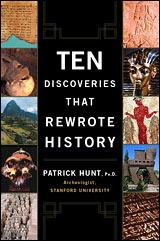
His latest book, "Ten Discoveries that Rewrote History," is due to be released later this month.

"If any global archaeologist were asked to name the top ten archaeological discoveries that have made the greatest impact on archaeology and history, most lists would be likely to unanimously mention the following huge impact discoveries: the Rosetta Stone, Pompeii, Nineveh, Troy, King Tut's Tomb, Machu Picchu, Thera-Akrotiri, the Dead Sea Scrolls, Olduvai Gorge starting with the Leakey Era and the Tomb of the Ten Thousand Warriors in China. This exciting book, written with a taut narrative, relates the dramatic moments of these discoveries, whether by professional archaeologists or by amateurs' accidents, and highlights their significance to history." - Penguin/Plume Publishers.

Contact Information: phunt@stanford.edu

Friday, July 27, 2007

Dr. Anise K. Strong


Anise K. Strong's primary areas of interest are Roman social history, gender and sexuality in the ancient world, and the reception of classical culture, especially in modern mass media. She is currently working on transforming her dissertation entitled, "Labeled Women: Roman Prostitutes and Persistent Stereotypes," into a book. She has published articles on ancient incest laws and sexuality in the HBO series "Rome," and has presented at multiple major conferences, including thrice at the American Philological Association annual meeting. She is an affiliate of the Classical Traditions Initiative.

Since I am passionately interested in the use of technology to facilitate the study of history, I was intrigued by a recent project she conducted within an introductory Roman Civilization course last spring.

"Each of the 115 students in the course edited or created a Roman history "stub" article on Wikipedia, ranging from the province of Gallia Aquitania to the house of Julia Felix in Pompeii. Each article contained references to at least one primary source from the ancient world (including images), one encyclopedic source, and one scholarly book or article. Each student also evaluated and commented on two-three other related student-written articles on their discussion pages.

Here's the link:
http://en.wikipedia.org/wiki/Wikipedia:School_and_university_projects#Northwestern_University_.28Spring_2007.29

It was a wonderfully successful project, although it will be difficult to repeat. Numerous students
- juniors and seniors - told me it was the first time they had ever had to check an actual book out of the library in their college career. Rather than generating a generic, useless paper, they
contributed to the sum of readily accessible human knowledge.


Contact info: Anise-strong@northwestern.edu

Sunday, May 27, 2007

Roman scholar Annette Gieseck honored by University of Delaware


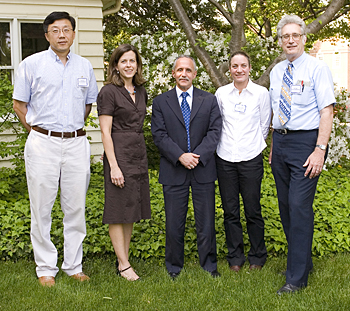
Annette Giesecke (second from the right), associate professor of foreign languages and literatures at the University of Delaware, received the institution's Outstanding Teaching Award May 24, 2007. The award is based on student and peer evaluations, alumni testimonials, the number and range of courses offered, involvement in individual instruction, quality of advisement and mentoring, demonstrated commitment to student welfare and development and an acknowledged reputation in teaching.

Giesecke is a professor in UD's classics program, teaching courses in ancient Greek and Latin as well as Greek and Roman literature and civilization in translation. She chaired Ancient Greek and Roman Studies and currently serves as director of Undergraduate Studies.

Her research interests are Latin and Greek poetry, Greek and Roman art and architecture and Utopianism in ancient Greece and Rome. She is the author of The Epic City: Utopia and the Garden in Ancient Greece and Rome and Atoms, Ataraxy and Allusion: Cross-Generic Imitation of the De Rerum Natura in Early Augustan Poetry.

Giesecke received her bachelor's degree in classics at the University of California at Los Angeles and her doctorate at Harvard University. She taught at Victoria University in New Zealand for four years and then taught at both UCLA and Loyola Marymount University before coming to UD in 1998.

At the ceremony on Honors Day, May 4, Giesecke was cited for her “deep passion for her subject [that] is inspiring to her students and colleagues.”

"

I am delighted to be part of the University of Delaware's dynamic Department of Foreign Languages and Literatures, and I feel that in joining the UD faculty, I have somehow come full circle. Allow me to explain. I am a native of Los Angeles and received my Bachelor's Degree in Classics at UCLA. A degree in Classics was not at all what I had visualized when I enrolled in college, because I intended to pursue a career in genetic engineering. Thanks to my high school ancient history teacher, whose enthralling narratives of the exploits of Alexander the Great kept me quite literally on the edge of my seat, and to my father, who can still recite from memory the proem of Homer's Odyssey which he had learned as a child, I decided to take Ancient Greek just for fun. Once I read the Iliad and the fabulous tales of Herodotus in the original, I was hooked. Upon completing my undergraduate work, I was fortunate enough to be offered a full scholarship to pursue graduate studies in Classical Philology at Harvard. It was in graduate school that I first experienced the seasons, the culture, and the profound sense of history which distinguish the East Coast.

In order to explore the possibility of a career in the museum world, I returned to Los Angeles as a curatorial intern in the Department of Antiquities at the J. Paul Getty Museum before writing my dissertation. In the course of my internship, I decided to focus on language and literature and began working on one of my favorite authors, the Roman poet Lucretius, whose powerful verses remain our most complete exposition of Epicurean philosophy. After completing my dissertation on the profound influence of Lucretius on the poetry and ideology of Virgil and Horace, I accepted a position as assistant professor of Classics at Victoria University in Wellington, New Zealand. There I taught courses ranging from Aeschylus' Agamemnon in Greek to Etruscan and Roman Art and Architecture. I also fell deeply in love with the rich Maori culture and the stunning scenery which make New Zealand a truly enchanted place. Four years later I returned to UCLA, this time on the opposite side of the podium. While I was dividing my time between teaching at UCLA and Loyola Marymount University, I was offered my present position at the University of Delaware and a chance to return to the East, now in a teaching capacity.

My interests have always been diverse, and as the field of Classics encompasses such a wide range of disciplines (history, philosophy, rhetoric, prose and poetry of all varieties, art, and archaeology included) it is the ideal field for me with respect to both research and teaching. My research interests are Latin poetry, particularly the epic poetry of Lucretius and Virgil; Greek tragedy; the Homeric epics; the relation between texts and images; and ancient painting. It is, however, Lucretius and his keen observation of phenomena in the natural world, the fervor of his essentially utopian vision, and the magnitude of his influence which remain the focus of my work. Strangely, Lucretius has never been regarded as a utopian author, and in applying the increasingly popular theories of utopics to the analysis of his verses, my aim is to demonstrate just how timely and relevant Classical antiquity remains.

As a teacher, I am a strong believer in the holistic approach to Classical antiquity. That is, I attempt to give students the broadest possible vision of the Greek and Roman world in literature, language, and myth courses alike by mingling historical material with ample illustrations of material culture as expressed in the arts, architecture, and other physical remains. Above all, my desire is to ensure that the study of Classics-the very roots of the Western heritage-remains alive and to demonstrate the versatility and usefulness of Classics as a major. Students who have had a Classical education are increasingly sought after by professional schools and businesses because they demonstrate the ability to write and reason, and this makes it especially exciting for me to be an integral part of the University's Classics program. "

Publications:

The Epic City: Urbanism, Utopia, and the Garden in Ancient Greece and Rome (Hellenic Studies Series)

"As Greek and Trojan forces battled in the shadow of Troy's wall, Hephaistos created a wondrous, ornately decorated shield for Achilles. At the Shield's center lay two walled cities, one at war and one at peace, surrounded by fields and pasturelands. Viewed as Homer's blueprint for an ideal, or utopian, social order, the Shield reveals that restraining and taming Nature would be fundamental to the Hellenic urban quest. It is this ideal that Classical Athens, with her utilitarian view of Nature, exemplified. In a city lacking pleasure gardens, it was particularly worthy of note when Epicurus created his garden oasis within the dense urban fabric. The disastrous results of extreme anthropocentrism would promote an essentially nostalgic desire to break down artificial barriers between humanity and Nature. This new ideal, vividly expressed through the domestication of Nature in villas and gardens and also through primitivist and Epicurean tendencies in Latin literature, informed the urban endeavors of Rome."

Journal for the Society for Utopian Studies:

Giesecke, Annette Lucia, Beyond the Garden of Epicurus: The Utopics of the Ideal Roman Villa 12.2 (2001): 13-32.

Giesecke, Annette Lucia, Lucretius and Virgil's Pastoral Dream 10.2 (1999): 1-15.


Office: 111 Jastak-Burgess Hall
Phone: 831-0545
E-mail: alg@udel.edu

Sunday, April 29, 2007

Jo-Ann Shelton, University of California at Santa Barbara


Telephone: 805-893-3806 Email: jshelton@classics.ucsb.edu

Professor
Ph.D., Berkeley 1974
Roman social and cultural history; Attitudes toward animals in the ancient and modern world; Roman and Greek tragedy; Roman epistolography.

>>Click here for a full CV

Books

  • As the Romans Did (second edition, Oxford 1998)
  • Seneca's Hercules Furens: Theme, Structure, and Style (Göttingen 1978)
  • Slavery and the Roman Literary Imagination (Cambridge University Press, 2000)
Abstract: "The study of slavery poses significant challenges for classical scholars. Slaves were numerous and ubiquitous in Roman society, and their almost constant presence surely affected the thoughts and behaviors of free persons. Many ancient writers, from almost every genre, provide information about the practice of slavery, but they do not describe what it was like to be a free person surrounded by and dependent upon other human beings whom one considered inferior, yet essential. The proverb quoted by Seneca, totidem hostes esse quot servos, reveals that the pleasures and profits of slave ownership were accompanied by anxieties. These anxieties are the topic of this engaging book. Fitzgerald analyzes representations of slavery in literary texts in order to illuminate the ways in which slave owners imagined, structured and interpreted their experiences of being attended by servants. In the introduction, Fitzgerald provides several definitions of the phrase "living with slaves," which he uses throughout to denote the situation of the slave owner. (Fitzgerald generally uses the noun "master" to designate the dominant figure in the relationship, and masculine pronouns to refer to slaves.) He notes that the Romans inherited from the Athenians a conceptual structure that defined slavery and freedom, like body and mind, as polar opposites, but he suggests that it was difficult to reconcile this [End Page 599] theoretical opposition with the various interactions between slaves and free persons in everyday life."

Selected Articles

  • "Putting Women in Their Place: Gender, Species and Hierarchy in Apuleius' Metamorphoses", in Defining Gender and Genre in Latin Literature, Peter Lang, New York (2005), pp. 301 - 329
  • "Dancing and Dying: The Display of Elephants in Ancient Rome Arenas", Daimonopylai, (ed. M. Joyal and R. Egan, Winnipeg 2004) 363-38
  • "The Spectacle of Death in Seneca's Troades", Seneca in Performance, (ed. George Harrison, London 2000) 87-118
  • "Elephants, Pompey and the Reports of Popular Displeasure in 55 B.C.", Veritatis Amicitiaeque Causa, (ed. S. Byrne and E. Cueva, Wauconda 1999) 231-271
  • "The Contributions of Ancient Greek Philosophy to the Modern Debates about Animal Use", Ancient Greece and the Modern World, (Patras 1998) 85-93
  • "Family Matters: The Structure and Dynamics of the Ancient Roman Family", Laetaberis 11 (1996) 1-27
  • "The Use and Abuse of Animals in Lucretius, De Rerum Natura", Eranos 94 (1996) 1-26
  • "Paradigm and Persuasion in Seneca's Ad Marciam", Classica et Medievalia 46 (1995) 157-188
  • "Contracts with Animals: Lucretius, De Rerum Natura", Between the Species 11 (1995) 115-121
  • "The Display of Elephants in the Ancient Roman Arena", ISAZ Newsletter (2001) 2-6

Sunday, March 11, 2007

Dr. Ray Howell, University of Wales, Newport

"For over a decade, Dr Howell has directed excavations at the decayed medieval urban site at Trelech, near Monmouth, in what was, in the 13th century, one of the two largest towns in Wales. Excavations there, largely conducted by UWCN undergraduate and postgraduate students, have revealed evidence of a presumed medieval hospice site, a motte and bailey castle, and large scale medieval and 17th century iron working.

Recently, Dr. Howell played an active part in the campaign to save the Newport Ship, an important late medieval vessel uncovered by workmen who were excavating the site for a new arts centre on the banks of the River Usk. The ship, which was dated to c.1465, has now been saved for posterity. During the campaign Dr Howell, who is the Council for British Archaeology’s honorary education officer for Wales, managed to enlist the support of Welsh actor and Hollywood star, Sir Anthony Hopkins, gaining some valuable publicity for the campaign.

Dr Howell is also currently working on the new five-volume Gwent County History. He is co-editing Volume I, Gwent from earliest times to the Norman conquest with Professor Miranda Aldhouse-Green of UWCN, and Volume II, Gwent from the Norman conquest to the Tudor accession, with Tony Hopkins of the Gwent County Record Office.

Dr. Howell’s research activities have attracted considerable media interest, with contributions to programmes for the BBC, HTV, S4C, Radio Wales, Radio Cymru and the BBC World Service. His most recent television appearance was in S4C’s major new series “Y Pompeii Cyntaf” which was broadcast in October and subsequently shown twice on S4C Digital." - Council for British Archaeology

Sunday, January 14, 2007

Thomas Samuel Burns


Dr. Thomas Samuel Burns
Emory University
Ph.D. The University of Michigan, 1974 under the co-direction of Sylvia L. Thrupp and John W. Eadie
contact: histsb@emory.edu

Work in Progress:

Comparative Study of Late Roman Urbanism in Pamphylia (southcentral Turkey) and the German Provinces on the Rhine and Upper Danube, being done in collaboration with colleagues at the University of Adelaide, Australia.

Archaeological Excavation of a Late Roman/ Early Medieval farmstead at Babarc, Hungary, 1989 to the present, renewed field excavations to run May through July 1998 with Prof. Drs. H. Bender and Z. Visy, technical analysis of findings and publication in progress.

“The Barbarian Invasion in the West: the First Generation, Initial Contacts, Confrontations, and Settlements.” As part of the encyclopedic Aufstieg und Niedergang der RÄmischen Welt. Geschichte und Kultur Roms in Spiegel der neueren Forschung ed. Wolfgang Haase. Professor Haase has set aside 50-80 pages of type for my contribution to the section “Politische Geschichte: Provinzen und Radvolker” of part three of the project on late antiquity.

Valentinian I (364-75 AD): An Iron Man with Vision a biography of one of the last great Roman leaders. He is the only remaining major Roman Emperor without a modern biography for whom amble evidence exists.


ARCHEOLOGICAL PROJECTS and NUMISMATIC PROJECTS (as co-director OR co-organizer):

1) Excavation of a Roman Military Watchtower, ca. 350-425 AD, at Passau-Haibach, with Prof. Dr. H. Bender, 1978 and 79.

2) Excavation of a Pre-Roman, Celtic Oppidum at Manching near Ingolstadt, a section with Prof. Dr. H. Bender, under the overall supervision of F. Maier, Römisch-Germanische Kommission, 1985.

3) Excavation of a Late Roman farmstead at Babarc near Mohacs, Hungary, 1989 – 99, Field Director, May through July, 1998. With Prof. Dr. Z. Visy, University of Pécs and Prof. Dr. Helmut Bender, Universität Passau. Publication in progress, anticipated 2005.

4) The traveling coin exhibition, “Rome and the Germans as Seen in Coinage,” originally organized in 1987, is now at its second venue in Australia after being shown at thirty locations in the United States, Canada, Australia and New Zealand. This exhibit is co-organized with Prof. Dr. Bernhard Overbeck, Staatliche Münzsammlung, München.

Books:

1) The Ostrogoths; Kingship and Society, Historia, Einzelschriften, No. 36, Franz Steiner Verlag, Wiesbaden, 1980.


2) A History of the Ostrogoths, Indiana University Press, Bloomington,1984. A selection of the History Book Club.

3) Rome and the Germans as Seen in Coinage, with Bernhard H. Overbeck (Emory University, Atlanta, 1987). A catalog for the exhibition.

4) Barbarians Within the Gates of Rome: Roman Military Policy and the Barbarians, ca. 375-425 A.D. Indiana University Press, Bloomington, 1994. A selection of the History Book Club.

5) Urban Centers and Rural Contexts in Late Antiquity, with John W. Eadie (East Lansing, Michigan State University Press, 2001)

6) Rome and the Barbarians, 100 BC to AD 400, (Baltimore, Johns Hopkins University Press, 2003). A selection of the History Book Club, the Discover Book Club, and the Reader’s Subscription Book Club.
Recent articles:

"The Twilight of Roman Raetia: An End and a Beginning," Exegesti Monumentum Aere Perennius: Essays in Honor of John Frederick Charles (Indianapolis, 1994) pp.1-18.

"Alaric, Stilicho and Radagaisus (402-06): Reflections upon Limits and Realities," in Minorities and Barbarians in Medieval Life and Thought [v.7, Sewanee Medieval Studies, ed. Susan Ridyard, Sewanee, TN, 1996] pp.141-58.

"Extending the Fulbright Teaching Experience: Internet Distance Learning," The Funnel. Newsmagazine of the German - American Fulbright Commission, 33.3 (Summer, 1997) pp.50-52.

"Imperial Propaganda and the Barbarians: Marius, Caesar, and Augustus," Humanitas – Beiträge zur antiken Kulturgeschichte. Festschrift für Gunther Gottlieb zum 65. Geburtstag, P. Barcelo and V. Rosenberger, eds. (Schriften der Philosophischen Fakultäten der Universität Augsburg, v.65, Munich, 2001) pp.63-79.

Medieval Italy. An Encyclopedia, edited by Christopher Kleinhenz, entries for Amalasuntha, Ostrogoths, Theodahad, Theodoric, Totila, and Witigis (Routledge, New York and London, 2004.

Recent Papers:

"Evolving Platforms of Roman and Barbarian Interaction, ca. 100 BC – AD 450," SUNY at Geneseo, Annual History Department Distinquished Lecture, September, 2000.

"Sometimes Bitter Friends, Romans, Barbarians, and the Birth of Europe," Tulane University, 29 October 2001.

“The Film Gladiator and Real Barbarians, Ancient and Modern,” Saint Marks’ College, Adelaide, Australia, September 2002.

“Perspective on Romans and Barbarians, ca. 100 BC – AD 400,” Victoria University, Wellington, New Zealand, September 2002.

“Hidden Realities: Foreigners on Rome Coinage,” Classical Association of South Australia meeting in Adelaide, October 2002.

“Time and Change as Seen from the Roman Attitudes towards Barbarians,” Post-Graduate Seminar in Classics and General Linguistics, University of Adelaide, Australia, October 2002.

“The Decline of the Ancient City in Late Roman Pamphylia, Southcentral Turkey,” University of Adelaide, Australia, October 2002.

“Rome and the Barbarians, 100 BC – AD 400,” Smithsonian Institution, November 2003.

“Jobs, Markets, and the Transformations of Roman Frontiers,” The Society for Hungarian Antiquities and the Pannonius University of Pécs, Hungary, June 2004.


Sunday, December 10, 2006

Richard P. Saller, new dean of Stanford's School of Humanities and Sciences


Stanford News Service:
University of Chicago Provost Richard P. Saller will be the next dean of Stanford's School of Humanities and Sciences (H&S). Saller is the Edward L. Ryerson Distinguished Service Professor of History and Classics at the University of Chicago. His research has concentrated on Roman social and economic history, in particular patronage relations and the family. He is interested in the use of literary, legal and epigraphic materials to investigate issues of social hierarchy and gender distinctions. He has taught there since 1984 and became dean of the Social Sciences Division in 1994 and provost in 2002. Prior to his tenure at Chicago, he was an assistant professor at Swarthmore College. He has held visiting professorships and fellowships at the University of California-Berkeley and Jesus College, Cambridge.

He is the author of several books, including Patriarchy, Property and Death in the Roman Family and Personal Patronage Under the Early Empire.

Saturday, December 02, 2006

Prof. Alan K. Bowman MA, PhD (Tor) FBA, Oxford University

Prof. Alan K. Bowman MA, PhD (Tor) FBA

Camden Professor of Ancient History, Faculty of Classics
Fellow, Brasenose College
Director, Vindolanda Writing Tablets
Director, Centre for the Study of Ancient Documents

Brasenose College
Oxford,
OX1 4AJ

Tel: (01865) 277874

alan.bowman@bnc.ox.ac.uk

Research Interests

Roman History and Papyrology

Selected Recent Publications

1994: The Vindolanda Writing Tablets (with J. D. Thomas), Tabulae Vindolandenses II British Museum Press.
1999: 'Agriculture in Egypt from Pharaonic to Modern Times' (with E. Rogan), Proceedings of the British Academy 96, Oxford.
2000: 'Urbanization in Roman Egypt', in Romanization and the City. Creation, transformations and failures ( ed. E. Fentress), Journal of Roman Archaeology Supplement, 38, 173-87.
2000: Cambridge Ancient History Vol. 11 'The High Empire' (with P.D.A. Garnsey, D.W.Rathbone), Cambridge.
2002: 'Recolonising Egypt,' in Classics in Progress: Essays on Ancient Greece and Rome, ed. T.P.Wiseman, British Academy, 193-224.
2003: Life and Letters on the Roman Frontier. Vindolanda and its People (New edition), British Museum Press, London.
2003: The Vindolanda Writing-Tablets (Tabulae Vindolandenses III) (with J.D.Thomas), British Museum Press, London, III.

Saturday, November 25, 2006

Dr. Craige B. Champion, Syracuse University


Craige B. Champion
Associate Professor of History
Department Chair

145 Eggers Hall / Syracuse University
Syracuse, NY 13244-1020
Tel. 315-443-2594 / Fax 315-443-5876
email:cbchamp@maxwell.syr.edu

Academic Specialization

Ancient Greek and Roman History, Greek and Roman Historiography, Ethnic Identity Formation in Classical Antiquity, Politics of Culture in Ancient Greece and Rome, Greek Democracy and Republican Rome, Imperialism in Classical Antiquity

Education

1. B.A. History, summa cum laude, College of New Jersey, 1984
2. Summer Latin/Greek Institute (CUNY), New York, New York: 1984 (Greek); 1986 (Latin)
3. M.A. Classics, Princeton University, 1989
4. PhD. Program of the History, Archaeology and Religions of the Ancient World, Princeton University, 1993
5. PhD. Classics, Princeton University, 1993

Recent Rome-related publications:

Roman Imperialism: Readings and Sources, Editor. Oxford: Basil Blackwell, 2004. Interpreting Ancient History Series. (ISBN 0-631-23118-8 hardback; 0-631-23119-6 paperback)

"Romans as Barbaroi: Three Polybian Speeches and the Politics of Cultural Indeterminacy," Classical Philology 95 (2000) 425-44

"Roman Classic Biases and Greek Political Strategies in the Second Century BC." Conference: Class
Struggles in Ancient Greece, 15-16 April, 2005, Scripps College, Claremont, CA, 4/16/05

"Roman Religion and Roman Statecraft in the Second Century BCE." Third International Conference on Hierarchy and Power in the History of Civilizations (Russian Academy of Sciences), Moscow,
Russia, 6/18/04

"Religion as a Mechanism for Social Control in the Roman Republic (ca. 220-ca. 185 BCE)." Workshop in Religion and Society, Department of History, Syracuse University, Syracuse, NY, 3/26/04

Friday, September 08, 2006

John R. Hale

"John R. Hale is the Director of Liberal Studies at the University of Louisville in Kentucky. He earned his B.A. at Yale University and his Ph.D. at Cambridge University in England. Dr. Hale teaches introductory courses on archaeology, as well as more specialized courses on the Bronze Age, the ancient Greeks, the Roman world, Celtic cultures, Vikings, and on nautical and underwater archaeology.

Dr. Hale's writing has been published in the journal Antiquity, The Classical Bulletin, the Journal of Roman Archaeology, and Scientific American. He is also the author of Lords of the Sea, a book about the ancient Athenian navy. Dr. Hale has received many awards for distinguished teaching, including the Panhellenic Teacher of the Year Award and the Delphi Center Award.

An accomplished instructor, Dr. Hale is also an archaeologist with more than 30 years of fieldwork experience. He has excavated at a Romano-British town in Lincolnshire, England, and at the Roman Villa of Torre de Palma in Portugal. He has also carried out interdisciplinary studies of ancient oracle sites in Greece and Turkey, including the famous Delphic Oracle, and participated in an undersea search in Greek waters for lost fleets from the time of the Persian Wars." - The Teaching Company

Education
B.A, Yale University, 1973
Honors: Lang Award for Classical Archaeology

Ph.D. in Archaeology, Cambridge University, 1979
Dissertation: Bronze Age Boats of Scandinavia

Recent publications:

A Report on the tombs and human skeletal remains at the Paleo-Christian basilica of Torre de Palma," Reunio d'Arqueologia Christiana Hispanica, IV, Barcelona, 1995.

"The lost technology of Ancient Greek rowing," Scientific American, May, 1996.

"The villa of Torre de Palma," Journal of Roman Archaeology, Vol. 9, 1996.

"Phormio Crosses the T," The Quarterly Journal of Military History, Vol. 8, 1996

"General Phormio's Art of War," Polis and Polemos: Essays on Politics, War, and History in Ancient Greece in Honor of Donald Kagan, California, 1997.

"The Viking Longship," Scientific American, February 1998.

"The Geological Origins of the Oracle at Delphi, Greece," (with Jelle de Boer) in The Archaeology of Geological Catastrophes, W.J. McGuive et al., eds., London 2000

Field Work

Fieldworker at Yale University survey of the Eli Whitney historical site, New Haven, Connecticut, 1972.

Field archaeologist at the University of Nottingham excavations at Dragonby, a Roman-British site in Lincolshire, 1972.

Survey of Bronze Age rock art in Southern Norway and Southwest Sweden, 1977.

Field director for Phase II survey of Riverfront Industrial Park, Jefferson County, Kentucky, 1980.

Field director for Phase I and II investigations of Otter Creek Park, Meade County, Kentucky, 1980-1981.

Field Director for University of Louisville's excavations at Roman Villa of Torre de Palma, 1984-present.

Archaeologist for interdisciplinary study of Geology and Monuments at Delphi, Greece, 1996-present.

Contact information:

hale@louisville.edu