Showing posts with label archaeologist. Show all posts

Wednesday, June 18, 2008

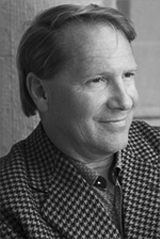
Professor David Mattingly


Professor of Roman Archaeology, University of Leicester, BA PhD FBA FSA

Following a BA in History at the University of Manchester, he completed a PhD under the supervision of Professor Barri Jones at the same University.


He was a British Academy Post-doctoral fellow at the Institute of Archaeology, Oxford (1986-1989), then Assistant Professor at the University of Michigan before coming to Leicester in December 1991 as a Lecturer. He was promoted to Reader (1995) and Professor (1998).

Heheld a British Academy Research Readership award from 1999-2001 and was elected Fellow of the British Academy in 2003.


Current Research Interests and Projects

His research has been wide-ranging in chronological and geographical terms, as well as in subject matter. There are strong unifying trends running through and he is essentially a specialist in the archaeology of the Roman empire. He is an active field archaeologist and has organised projects in Britain, Italy, Libya, Tunisia and Jordan.

A significant component throughout his career to date has been the study of Roman Africa. His main contributions to the advancement of Roman Africa studies have been in terms of study of rural settlement, farming technology and the economy; urbanism and the urban economy; post-colonial approaches to the impact of Rome; the evolution of the Roman military frontiers and, latterly, the study of native society beyond those frontiers. He was a major author of the final reports on the UNESCO Libyan Valleys Survey, and helped initiate work in 1990 at an important Tunisian harbour site called Leptiminus, leading to two published volume of reports, with a third co-edited volume in progress. Recently, the Fazzan Project in Libya has taken him beyond the boundaries of the Roman empire to research the Saharan heartlands of an important people called the Garamantes. This Sahara work has now entered a new phase as the Desert Migration Project.

A second research strand developed from his Oxford-based post-doctoral research into olive cultivation in the Roman world and the production of olive oil and its trade.

A third area of research has been rural field survey, where he has published final reports on multi-period work near Rieti in Italy and in Libya, whilst a monograph on co-directed work in Jordan (Wadi Faynan) is in an advanced state of preparation. Other areas of interest include Roman Britain, imperialism in the Roman world, Roman economic and social history and cartography of the ancient world.

He has authored, co-authored, edited or co-edited 18 monographs. Several others are in preparation. In addition he has written (or contributed to) 140 published articles/chapters, 8 review articles and about 150 other book reviews or minor works.

Recent Publications

  • (with G. Barker and D. Gilbertson et al.) Archaeology and Desertification: the Wadi Faynan Landscape Survey, southern Jordan. Oxbow, CBRL, Oxford (in press).
  • (with C.M. Daniels, J.N. Dore, D. Edwards and J. Hawthorne). The Archaeology of Fazzan. Volume 2, Site Gazetteer, Pottery and Other Survey Finds. London (2007). Pp xxx and 522. (edited by D. Mattingly).
  • (edited with G. Shipley, J. Vanderspoel and L. Foxhall,). The Cambridge Dictionary of Classical Civilization. Cambridge University Press, Cambridge (2006). Pp. xliv and 966.
  • An Imperial Possession. Britain in the Roman Empire. Penguin History of Britain Series. London (2006). Pp. xvi and 622. (Paperback edition 2007 with minor corrections).
  • (edited with S. McLaren, E. Savage, Y al-Fasatwi and K. Gadgood). The Libyan Desert: Natural Resources and Cultural Heritage. Society for Libyan Studies, London (2006). Pp. x and 338.
  • (with C.M. Daniels, J.N. Dore, D. Edwards and J. Hawthorne) The Archaeology of Fazzan: Volume 1 (Synthesis, London, 2003), pp. xxvi and 430, 460 figures (edited by D. Mattingly).
  • (with L. Stirling and N. Ben Lazreg). Leptiminus (Lamta): Report no. 2, The East Baths, Cemeteries, Kilns, Venus Mosaic, Site Museum and other studies Portsmouth, RI, JRA Suppl. 40. (2001), pp. 464. See also (with N. Ben Lazreg and contributions from others). Leptiminus (Lamta): a Roman port city in Tunisia, Report no. 1. Ann Arbor (1992), pp. 333
  • (edited with J. Salmon). Economies beyond Agriculture in the Classical World. (Leicester Nottingham Ancient History Seminar Series, Routledge. (2001 [2000]), pp. xii and 324
  • (edited with D. Potter). Life, Death and Entertainment in Ancient Rome. (Ann Arbor, University of Michigan Press). (1999), pp. xiv and 353
  • (edited). Dialogues in Roman Imperialism. Power, Discourse and Discrepant Experience in the Roman Empire (Journal of Roman Archaeology, Suppl. vol 23), Portsmouth, RI (1997), pp. 200
  • (with G.W.W. Barker, D.D. Gilbertson and G.D.B. Jones). Farming the Desert The UNESCO Libyan Valleys Archaeological Survey. Volume 1, Synthesis. (principal editor, G. Barker), UNESCO, Soc. for Libyan Studies, Paris/London (1996), pp. xx and 404; Volume 2, Gazetteer and Pottery (principal editor, D.J. Mattingly), UNESCO, Soc. for Libyan Studies, Paris/London (1996), pp. xxii and 394
  • Tripolitania. Batsford, London (1995), pp. xxii and 266

Contact Details:

Tuesday, October 02, 2007

Patrick Hunt, Stanford University

Archaeologist, artist, poet, musician...the talents of Dr. Patrick Hunt of Stanford University seem boundless and he has applied those talents in a variety of arenas as he strives to share his passion about Rome and the ancient world with people worldwide through his research, his writings, his participation in educational broadcasts, his tours, his illustrations, and his musical compositions.

Current Research:

"Dr. Hunt has directed Stanford’s Alpine Archaeology Project since 1994, conducting high altitude research in the Great St. Bernard pass between Switzerland and Italy. In 1996 he found the 9000 ft. high quarry for the Temple of Jupiter in the Fenetre de Ferret pass adjacent to the Great St. Bernard Pass and has directed a team that found a Roman silver coin hoard in the Swiss Alps in 2003. Another of his research interests has been to track Hannibal who crossed the Alps in 218 BCE with an army accompanied by elephants. He has led annual teams across at least ten Alpine passes in search of topographic clues matching the texts of Polybius and Livy who wrote about Hannibal nearly two millennia ago, including multiple Stanford teams between 1996 and 2006.

Three of Dr. Hunt's lectures about Hannibal can be downloaded from Stanford's iTunes U directory.

He has lived in London, Athens and Jerusalem as well as annual time spent in Switzerland, France, Italy every year since 1994, among many other countries, and has also conducted archaeological research in Peru on Inca sites and on Olmec, Maya and Aztec cultures in Central America.

Dr. Hunt has been published on such diverse topics as monuments like the Pantheon, ancient notables such as Gyges from Herodotus, linguistics, biblical studies, the origin of Byzantine Silk, studies in Hebrew poetry and literary wordplay, Roman monuments in operas, calendrical megaliths, Olmec and Maya sculpture, iconography on Greek vases and myth palindromes, nautical exploration, art history, Egyptian stone working and Phoenician lore and geoarchaeology among many other topics.

His academic publications include many journal and encyclopedia entries in peer-reviewed articles such as WORLD ARCHAEOLOGY (1989), BULLETIN OF THE INSTITUTE OF CLASSICAL STUDIES (1988), PAPERS OF THE INSTITUTE OF ARCHAEOLOGY, LONDON (1990), STUDIA PHOENICIA (1991), BEITRAGE FUR ERFORSCHUNG DES ALTEN TESTAMENTS (1992 & 1996), JOURNAL OF ROMAN ARCHAEOLOGY (1998), VOLCANOES, EARTHQUAKES AND ARCHAEOLOGY published by the Royal Geological Society (2000), ACTA of the XIIIth International Bronze Congress at Harvard University (2003), ENCYCLOPEDIA OF THE ANCIENT WORLD (2003) and GREAT EVENTS IN WORLD HISTORY (2004). He has been a Fellow of the Royal Geographical Society since 1989, named in WHO'S WHO IN BIBLICAL STUDIES AND ARCHAEOLOGY (1993) and he has also served as President of the Archaeological Institute of America’s Stanford Society since 1995. Patrick's primary archaeology book of 2007 is titled ALPINE ARCHAEOLOGY." -- Patrick Hunt.net

Many of Dr. Hunt's articles are featured on the website, "Philolog: Classical connections - commentary and critique", a rich resource for art historians, students and all lovers of classical art. His articles including "Arborisms in Ovid's Baucis and Philemon from Metamorphoses" are cited by the Cambridge School Classics Project in their efforts to promote classical studies. An excerpt:

"Perhaps to intensify the transformation of the two old people whose theoxeny - hospitality to their anonymous divine guests (Jupiter and Mercury) - is unique, Ovid fashions and foreshadows their future nature as trees by filling his poetic text with at least 30 references to wood or forest plants. This is a brief catalog of Ovid's passage with possible arboreal interpretations and allusions.

First, Ovid has his narrator (Lelex) tell about what he has seen growing side by side in the Phrygian hills, long after the transformation in their anonymous almost endless life as the yet-unnamed Baucis and Philemon are an oak (quercus) and linden (tilia) tree intertwined (tiliae contermina quercus 8.620).

Second, Philemon welcomes the gods to enter the poor couple’s forest hovel – whose roof is reeds and stalks of straw (stipulis et canna 8.630) - by way of a [wooden] gabled doorpost (vertice postes 8.638) (1). Baucis pulls off dry twigs and stems (ramaliaque arida 8.644) from the thatched roof as tinder for the meal’s fire. Then, using a forked stick (furca…bicornis 8.646) Philemon unhooks dried meat from a blackened wooden beam (nigro…tigno 8.648) and also unfastens a beech wood tub (alveus…fagineus 8.652-3) tub for bathing limbs.(2) Baucis sets up a couch of willow (salignus 8.656) and a wooden table for the fare. The mattress for the gods’ couch is also of soft sedge plants (molli…ulva 8.655). On the one hand, Ovid is accentuating their poverty, as Due mentioned - "praise of the poor but honest simplicity"(3) - so that all their furniture, old and battered, and all household accoutrements mentioned are of wood, hardly surprising given their meager resources, but the wood references are unnecessarily ubiquitous unless Ovid is creating an extended metaphor... More.

Dr. Hunt has been featured on The History Channel in one of my favorite series, "Engineering An Empire: Carthage" and "Engineering an Empire: "The Persians". His research on Hannibal's passage through the Alps will be featured in an upcoming program on The National Geographic Channel.

As a musician and composer, he has been awarded the ASCAPlus Award for Classical and concert music composed and performed in both 2007 and 2008, including several premiere arias from his opera BYRON IN GREECE.

Among many classical music works, he has written piano, choral and chamber music and is a Full Writer member of ASCAP since 1980 when some of his choral songs were published along with a movie score he composed. In 1999, a Duke University musical group performed his SONGS OF EXILE: By the Rivers of Babylon in Washington, DC, Raleigh and at Duke. He also set William Blake poems to choral music that was performed at Stanford in February, 2005.

"Dr. Hunt illustrated Richard Martin’s MYTHS OF THE ANCIENT GREEKS (New American Library-Penguin, 2003) and has illustrated his newest book of poems, HOUSE OF THE MUSE: Poems from the British Museum, newly published in the summer of 2005. His many poetry publications include poems in YOUNG AMERICAN POETS (1978), POET LORE (1978) and CLASSICAL OUTLOOK (1991). He is also translating Greek poets like Sappho and encyclopedists like Theophrastus.

Along with monographs, novellas, and other writing, Dr. Hunt wrote CARAVAGGIO, an art historical biography and critical book on the Baroque genius painter, published in London in 2004. It has been highly acclaimed in reviews including the ART NEWSPAPER International in London (December 2004) where it was described as “first-class” and “a rattling good yarn.” -- Patrick Hunt.net

He was invited to the Sun Valley Writers’ Conference in August, 2005, where he presented Myths Deeper Truths."

"Mythology is one of the deepest creative responses of humanity to the search for universals," Dr. Hunt observes, " Each great myth is often so profound and rich in mystery as to have not one but many possible meanings that are rediscovered and savored at different points in life. It is likely that each human who searches through myth is somehow elevated thereby."

To reintroduce myths to a modern audience Dr. Hunt is rewriting them, adding fictional dialog to the narrative. His retelling of Endymion was well received at the Writer's Conference and will be incorporated into a book due out later this year. An excerpt:

"While waiting for the moon, which would be full this night, Endymion turned and counted the brilliant stars on the other horizon. He looked at the familiar late winter constellations. Orion was already descending to the northwest and only his dogs still ran across the sky. Not far away the dim campfire was now silent as their wine stupefied the other sleeping shepherds. Endymion was sad over his loveless life. He remembered the goddess Artemis was also the moon, and he knew she was a virgin like himself, sworn to protect her chastity. He made a little prayer to the goddess.

“O Goddess of the Lonely Moon, hear my prayer. I know you have chosen your life, but I too am lonely. I ask your help to remain pure to the one I will love lifelong. Help me in my loneliness to wait for her.”

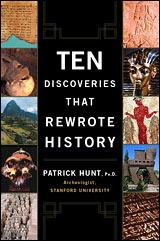
His latest book, "Ten Discoveries that Rewrote History," is due to be released later this month.

"If any global archaeologist were asked to name the top ten archaeological discoveries that have made the greatest impact on archaeology and history, most lists would be likely to unanimously mention the following huge impact discoveries: the Rosetta Stone, Pompeii, Nineveh, Troy, King Tut's Tomb, Machu Picchu, Thera-Akrotiri, the Dead Sea Scrolls, Olduvai Gorge starting with the Leakey Era and the Tomb of the Ten Thousand Warriors in China. This exciting book, written with a taut narrative, relates the dramatic moments of these discoveries, whether by professional archaeologists or by amateurs' accidents, and highlights their significance to history." - Penguin/Plume Publishers.

Contact Information: phunt@stanford.edu