Showing posts with label Roman. Show all posts

Sunday, December 07, 2008

Andrew Feldherr, Princeton

Phone: 609-258-3953
Email: feldherr@princeton.edu

Background:

Professor Feldherr graduated from Princeton in 1985 and received his Ph.D. from Berkeley in 1991. He is the author of Spectacle and Society in Livy's History (Berkeley, 1998) as well as articles on Vergil, Ovid, and Catullus and is currently at work on a book exploring the political aspects of fictionality in Ovid's Metamorphoses. Teaching interests include Roman Drama and Satire, as well as Roman Cultural History.


Technorati Tags: , , , , , ,

Denis Feeney, Princeton

Phone: 609-258-7060
Email: dfeeney@princeton.edu

B.A., M.A. Auckland University ’76; D. Phil. Oxford University ’82

Professor Feeney teaches in the area of Latin poetry in particular, and has published two books on the interaction between Roman literature and religion (The Gods in Epic; Literature and Religion at Rome), with another on Roman representations of time (Caesar's Calendar). He is currently working on a book tentatively entitled Roman Horizons, on the way the Romans modernised themselves in the third and second centuries BCE.

Books:

The Gods in Epic: Poets and Critics of the Classical Tradition (Oxford University
Press, 1991)

Literature and Religion at Rome: Cultures, Contexts, and Beliefs (Cambridge
University Press, 1998) trans. Claudio Salone, ed. Piergiorgio Parroni, Letteratura e religione nell’antica
Roma: culture, contesti e credenze (Salerno Editrice, Rome, 1999)

Caesar’s Calendar: Ancient Time and the Beginnings of History (University of
California Press, forthcoming, May 2007)

Recent Articles:


‘Leaving Dido: the appearance(s) of Mercury and the motivations of Aeneas’, in
A Woman Scorn’d: Responses to the Dido Myth, ed. M. Burden (London, 1998),
105-27

‘Epic violence, epic order: Killings, catalogues, and the role of the reader in
Aeneid 10’, in Reading Vergil’s Aeneid: An Interpretive Guide, ed. Christine
Perkell (Oklahoma, 1999), 178-94

‘Mea tempora: Patterning of time in Ovid’s Metamorphoses’, in P. Hardie, A.
Barchiesi and S. Hinds (eds.), Ovidian Transformations: Essays on Ovid’s
Metamorphoses and its reception (Cambridge Philological Society,
Supplementary vol. 23, Cambridge, 1999), 13-30

‘The odiousness of comparisons: Horace on Synkrisis’, in M. Paschalis (ed.),
volume on Horace, forthcoming, University of Crete

‘Una cum scriptore meo: poetry, principate, and the traditions of literary history
in the Epistle to Augustus’, in T. Woodman and D. Feeney (eds.), Traditions and
Contexts in the Poetry of Horace, forthcoming, Cambridge University Press

‘Introduction’, in Ovid: Metamorphoses. A New Verse Translation, tr. D.
Raeburn (Penguin, 2004), xiii-xxxvi

‘Interpreting sacrificial ritual in Roman poetry: disciplines and their models’, in
A. Barchiesi, J. Rüpke and S. Stephens (eds.), Rituals in Ink: A Conference on
Religion and Literary Production in Ancient Rome held at Stanford University in
February 2002 (Stuttgart, 2004), 9-29

‘Tenui…latens discrimine: spotting the differences in Statius’ Achilleid’,
Materiali e Discussioni 52 (2004), 85-105

‘The beginnings of a literature in Latin’, Journal of Roman Studies 95 (2005),
226-40 (Review Article of W. Suerbaum (ed.), Handbuch der lateinischen
Literatur der Antike. Erster Band: Die archaische Literatur. Von den Anfängen
bis zu Sullas Tod. Die vorliterarische Periode und die Zeit von 240 bis 78 v. Chr.
(Handbuch der Altertumswissenschaft VIII.1, Munich, 2002))

‘Two Virgilian acrostics: certissima signa?’, with Damien Nelis, Classical
Quarterly 55 (2005), 644-6


Technorati Tags: , , , , , , ,

Edward Champlin, Princeton

Phone: 609-258-3959
Email: champlin@princeton.edu


B.A. Toronto ’70, D.Phil. Oxford ’76.


Professor Champlin works
on Roman social and literary history of the late Republic and early
Empire, and on Roman law. His books include Fronto and Antonine
Rome
; Final Judgments: Duty and Emotion in Roman Wills;
and Nero. He is currently interested in the uses of myth
in Roman public and private life.

Other Publications:

“Phaedrus the Fabulous”, Journal of Roman Studies 95 (2005) 97-123


Yelena Baraz, Princeton University

Phone: 609-258-3956
Email: ybaraz@princeton.edu

B.A. Brooklyn College, CUNY '97; Ph.D. UC Berkeley '04.

Professor Baraz specializes in Latin literature and Roman culture. She is interested in how literary texts shape, and are in turn shaped by, social and cultural forces. She is currently completing a book manuscript entitled Cicero's Philosophical Politics that locates the body of philosophical work Cicero produced in the 40s BCE under Caesar's dictatorship in its historical and cultural context. She is also working on a new project that explores the meaning of pride and related concepts in Roman society (a paper on this subject is forthcoming in "Kakos": Badness in Classical Antiquity, Ralph Rosen and Ineke Sluiter, edd., Brill 2008).


Technorati Tags: , , , , , , , ,

Monday, August 25, 2008

Philip Freeman

Associate Professor of Classics, Luther College

Contact: freeph01@luther.edu
Department of Classics
Luther College
Decorah, Iowa 52101
USA
(563) 387-2144

"When I was a boy, I cared much more about comic books than Homer or Virgil. My father was stationed in Italy for a year when I was twelve. I spent the whole time earning Boy Scout merit badges and bowling with my friends rather than trekking around the country looking at Roman ruins. When I got back to the states and entered high school, I signed up for French rather than Latin because a dead language was the last thing I was interested in.

When I started my first year of college I thought Latin might be fun (and not too hard). I lasted a week before I dropped the class. I just couldn't understand the notion of declensions, verb-final syntax, and the dreaded ablative case. But I eventually gave it another try and persevered. Then I ended up adding Greek, mythology, and archaeology classes to my schedule until I figured out I might as well be a Classics major. By the time I was nearing the end of my undergraduate years, I decided that I wanted to teach in college even though I had never taught anything to anyone up to that point.

There's nothing quite as much fun as standing in front of a group of college students and opening new worlds to them. It's such a privilege that I would probably do it for free (don't tell the dean I said that). There's nothing better than sharing stories with bright young people about Achilles and how anger can destroy a person's life; or Odysseus and why he gave up immortality; or Dante and how the worst sin you could ever commit isn't murder, but betrayal of someone who loves you.

I've taught at Harvard University, Boston University, Washington University, and now Luther College in the beautiful hills (yes, hills) of northeast Iowa. I've also been a visiting scholar at the Harvard Divinity School, the American Academy in Rome, and the Center for Hellenic Studies in Washington, D.C. I've given talks on the ancient world at the Smithsonian Institution and interviews on National Public Radio, but my best audience ever was a class of enthusiastic elementary school students in St. Louis.

A few years ago, I decided that I wanted to share stories about the ancient world with an audience beyond my students, so I started writing books for anyone with a library card."

Freeman holds the Orlando W. Qualley Chair of Classical Languages at Luther College. He is an internationally recognized specialist in Greek, Roman, medieval culture and Celtic studies.

Publications include:

The Letters of St. Patrick - This is a bilingual Latin/English edition of St. Patrick's forthcoming from the Library of Early Christianity series published by the Catholic University of America Press. It will also include an early life of Patrick written by the seventh-century Irish churchman Muirchú.

War, Women, and Druids: Eyewitness Reports and Early Accounts of the Ancient Celts (University of Texas Press, 2002) - If you want to read in English almost every important passage about the ancient Celts that survives in Greek and Roman authors, you'll like this handy sourcebook.

The Galatian Language (Ancient Near Eastern Texts and Studies vol. 13) (Mellen Press, 2001) - A small collection of every scrap remaining from the language of the Galatians, migrating Celts who ended up in Asia Minor in the third century BC (St. Paul wrote to them in his New Testament letter).

Ireland and the Classical World (University of Texas Press, 2001) - Ireland interacted with Greece and Rome centuries before St. Patrick arrived. This book is a comprehensive study of all the literary, linguistic, and archaeological sources for this contact. Greek and Latin texts are included, but I also translate everything.

"Teaching the Bhagavad-Gita in a Traditional Great Books Program" in Uniting the Liberal Arts: Core and Context (B. Cowan, ed., University Press of America, 2002) 113-116 - I had such a great time teaching this ancient Indian text in the Core Curriculum program at Boston University that I wanted to share a few tips with anyone else who might want to include it in a course.

"The Survival of the Etruscan Language" Etruscan Studies 5: 75-84 (1999) - This article looks at the evidence for how long the language of the ancient Etruscans of Italy survived.

"The Earliest Greek Sources on the Celts" Etudes Celtiques 32: 11-48 (1996) - More than you ever wanted to know about Greek sources on the Celts dating from 500 to 300 BC. This article was based on part of my doctoral dissertation.

"Visions from the Dead in Herodotus, Nicander of Colophon, and the Táin Bó Cúailnge" Emania 12: 45-48 (1994) - We know from Posidonius and Caesar that the Celts believed in an afterlife, but the earliest evidence comes from a fragment of the Greek writer Nicander. He says the ancient Celts used to visit the graves of their ancestors seeking visions, a ritual also found in medieval Irish stories.

Monday, December 24, 2007

Thomas McGinn


Thomas A.J. McGinn
2933 Polo Club Road
Nashville, TN 37221-4346

(615) 371-5245 (tel.)
(615) 371-1301 (fax)

thomas.a.mcginn@vanderbilt.edu
tommcginn@comcast.net

Harvard College B.A. magna cum laude 1978
Cambridge University M.A. 1980
University of Michigan Ph.D. 1986

Title of Dissertation: Prostitution and Julio-Claudian Legislation: The Formation of
Social Policy in Early Imperial Rome

Special Areas of Interest: Roman Law and Social History

Recent Publications:

Books:
1. Prostitution, Sexuality, and the Law in Ancient Rome (Oxford University Press: 1998)
Paperback edition published by Oxford University Press in January 2003

2. A Casebook on Roman Family Law (coauthor with Bruce Frier: Oxford University Press: October 2003)

3. The Economy of Prostitution in the Roman World: A Study of Social History and the Brothel (University of Michigan Press: February 2004)

Recent articles and/or chapters:

Historia: Zeitschrift für alte Geschichte 53.2 ( 2004) 200-208: Missing Females?: Augustus’ Encouragement of Marriage Between Freeborn Males and Freedwomen

in J.-J. Aubert and A.J.B. Sirks eds., Speculum Iuris: Roman Law as a Reflection of
Economic and Social Life (University of Michigan Press 2002) 46-93: The Augustan
Marriage Legislation and Social Practice: Elite Endogamy vs. Male “Marrying Down”

Proceedings of the Cambridge Philological Society 47 (2001) 81-102: Satire and the Law:
The Case of Horace

Abstract from work review:

"As an example selected very nearly at random, consider Case 8, "The ability to procreate" (29-30). Citing Justinian's Digest (D. 23.3.39.1, Ulpian in the thirty-third book on the Edict), the case examines whether a woman can validly marry a eunuch (spado, more generally a sterile or impotent male, as the authors point out on p. 363) and whether the latter may therefore receive a dowry. Ulpian distinguishes those whose infertility has been caused by castration, on one hand, from those whose condition results from unspecified (presumably natural) causes, on the other. The former cannot marry, concludes the jurist without further elaboration, but the latter can.

Ulpian's reasoning in this instance is elusive, to say the least. F/M describe the distinction as "odd," but point out that it is operative in other instances as well. Apparently there is some stigma attaching to castration, and not to infertility in general, that raises a bar to marriage. F/M ask: is Ulpian's objection founded upon morality? "Does Ulpian presume that the eunuch's castration was deliberate, not accidental? And if deliberate, who bears the blame?"

My own experiences in discussing this and comparable material with undergraduates suggest that the topic of deliberate castration in antiquity offers fodder for wide-ranging, if not always well-focused, discussions about cultural difference. F/M direct their reader instead to a topic of great cross-cultural interest and considerable contemporary political, legal, and social topicality: "in the Roman world, as in many other past and present societies, a strong tradition linked marriage to the procreation of children[...]. Nonetheless, as this Case shows, inability to beget children was not in itself necessarily a bar to marriage." To what extent does this concession undermine constructions of "traditional" marriages and families? Granting that the sources cannot definitively answer the question one way or other, F/M invite their reader to consider how a proposal to recognize same-sex marriage might fare in the hands of the Roman jurists: "are Roman policies linking marriage and procreation enough to make same-sex marriage impossible?"

While the approach of the cases as a whole in the volume is less hypothetical and speculative than this single instance might suggest, this case does illustrate the extent to which volume as a whole is conceived as an introduction to, and an exercise in, legal reasoning in general as well as Roman family law in particular. The authors suggest that to encounter this law is to encounter social and historical difference in a manner that challenges "the tacit presumptions of modern family life" and problematizes the claim of any particular family formation to be "authentically 'traditional,'" and they note the extent to which family relationships and the claims of nontraditional families have become subject to legal scrutiny in recent decades (3). At the same time, the reader is warned that the juristic sources "must always be appreciated as a set of primarily legal institutions, not as an anthropological description of actual Roman family life" (11) and that they concern themselves largely with the needs and interests of a landed elite (6)." - Bryn Mawr Classical Review 2005.04.32

Tuesday, October 02, 2007

Patrick Hunt, Stanford University

Archaeologist, artist, poet, musician...the talents of Dr. Patrick Hunt of Stanford University seem boundless and he has applied those talents in a variety of arenas as he strives to share his passion about Rome and the ancient world with people worldwide through his research, his writings, his participation in educational broadcasts, his tours, his illustrations, and his musical compositions.

Current Research:

"Dr. Hunt has directed Stanford’s Alpine Archaeology Project since 1994, conducting high altitude research in the Great St. Bernard pass between Switzerland and Italy. In 1996 he found the 9000 ft. high quarry for the Temple of Jupiter in the Fenetre de Ferret pass adjacent to the Great St. Bernard Pass and has directed a team that found a Roman silver coin hoard in the Swiss Alps in 2003. Another of his research interests has been to track Hannibal who crossed the Alps in 218 BCE with an army accompanied by elephants. He has led annual teams across at least ten Alpine passes in search of topographic clues matching the texts of Polybius and Livy who wrote about Hannibal nearly two millennia ago, including multiple Stanford teams between 1996 and 2006.

Three of Dr. Hunt's lectures about Hannibal can be downloaded from Stanford's iTunes U directory.

He has lived in London, Athens and Jerusalem as well as annual time spent in Switzerland, France, Italy every year since 1994, among many other countries, and has also conducted archaeological research in Peru on Inca sites and on Olmec, Maya and Aztec cultures in Central America.

Dr. Hunt has been published on such diverse topics as monuments like the Pantheon, ancient notables such as Gyges from Herodotus, linguistics, biblical studies, the origin of Byzantine Silk, studies in Hebrew poetry and literary wordplay, Roman monuments in operas, calendrical megaliths, Olmec and Maya sculpture, iconography on Greek vases and myth palindromes, nautical exploration, art history, Egyptian stone working and Phoenician lore and geoarchaeology among many other topics.

His academic publications include many journal and encyclopedia entries in peer-reviewed articles such as WORLD ARCHAEOLOGY (1989), BULLETIN OF THE INSTITUTE OF CLASSICAL STUDIES (1988), PAPERS OF THE INSTITUTE OF ARCHAEOLOGY, LONDON (1990), STUDIA PHOENICIA (1991), BEITRAGE FUR ERFORSCHUNG DES ALTEN TESTAMENTS (1992 & 1996), JOURNAL OF ROMAN ARCHAEOLOGY (1998), VOLCANOES, EARTHQUAKES AND ARCHAEOLOGY published by the Royal Geological Society (2000), ACTA of the XIIIth International Bronze Congress at Harvard University (2003), ENCYCLOPEDIA OF THE ANCIENT WORLD (2003) and GREAT EVENTS IN WORLD HISTORY (2004). He has been a Fellow of the Royal Geographical Society since 1989, named in WHO'S WHO IN BIBLICAL STUDIES AND ARCHAEOLOGY (1993) and he has also served as President of the Archaeological Institute of America’s Stanford Society since 1995. Patrick's primary archaeology book of 2007 is titled ALPINE ARCHAEOLOGY." -- Patrick Hunt.net

Many of Dr. Hunt's articles are featured on the website, "Philolog: Classical connections - commentary and critique", a rich resource for art historians, students and all lovers of classical art. His articles including "Arborisms in Ovid's Baucis and Philemon from Metamorphoses" are cited by the Cambridge School Classics Project in their efforts to promote classical studies. An excerpt:

"Perhaps to intensify the transformation of the two old people whose theoxeny - hospitality to their anonymous divine guests (Jupiter and Mercury) - is unique, Ovid fashions and foreshadows their future nature as trees by filling his poetic text with at least 30 references to wood or forest plants. This is a brief catalog of Ovid's passage with possible arboreal interpretations and allusions.

First, Ovid has his narrator (Lelex) tell about what he has seen growing side by side in the Phrygian hills, long after the transformation in their anonymous almost endless life as the yet-unnamed Baucis and Philemon are an oak (quercus) and linden (tilia) tree intertwined (tiliae contermina quercus 8.620).

Second, Philemon welcomes the gods to enter the poor couple’s forest hovel – whose roof is reeds and stalks of straw (stipulis et canna 8.630) - by way of a [wooden] gabled doorpost (vertice postes 8.638) (1). Baucis pulls off dry twigs and stems (ramaliaque arida 8.644) from the thatched roof as tinder for the meal’s fire. Then, using a forked stick (furca…bicornis 8.646) Philemon unhooks dried meat from a blackened wooden beam (nigro…tigno 8.648) and also unfastens a beech wood tub (alveus…fagineus 8.652-3) tub for bathing limbs.(2) Baucis sets up a couch of willow (salignus 8.656) and a wooden table for the fare. The mattress for the gods’ couch is also of soft sedge plants (molli…ulva 8.655). On the one hand, Ovid is accentuating their poverty, as Due mentioned - "praise of the poor but honest simplicity"(3) - so that all their furniture, old and battered, and all household accoutrements mentioned are of wood, hardly surprising given their meager resources, but the wood references are unnecessarily ubiquitous unless Ovid is creating an extended metaphor... More.

Dr. Hunt has been featured on The History Channel in one of my favorite series, "Engineering An Empire: Carthage" and "Engineering an Empire: "The Persians". His research on Hannibal's passage through the Alps will be featured in an upcoming program on The National Geographic Channel.

As a musician and composer, he has been awarded the ASCAPlus Award for Classical and concert music composed and performed in both 2007 and 2008, including several premiere arias from his opera BYRON IN GREECE.

Among many classical music works, he has written piano, choral and chamber music and is a Full Writer member of ASCAP since 1980 when some of his choral songs were published along with a movie score he composed. In 1999, a Duke University musical group performed his SONGS OF EXILE: By the Rivers of Babylon in Washington, DC, Raleigh and at Duke. He also set William Blake poems to choral music that was performed at Stanford in February, 2005.

"Dr. Hunt illustrated Richard Martin’s MYTHS OF THE ANCIENT GREEKS (New American Library-Penguin, 2003) and has illustrated his newest book of poems, HOUSE OF THE MUSE: Poems from the British Museum, newly published in the summer of 2005. His many poetry publications include poems in YOUNG AMERICAN POETS (1978), POET LORE (1978) and CLASSICAL OUTLOOK (1991). He is also translating Greek poets like Sappho and encyclopedists like Theophrastus.

Along with monographs, novellas, and other writing, Dr. Hunt wrote CARAVAGGIO, an art historical biography and critical book on the Baroque genius painter, published in London in 2004. It has been highly acclaimed in reviews including the ART NEWSPAPER International in London (December 2004) where it was described as “first-class” and “a rattling good yarn.” -- Patrick Hunt.net

He was invited to the Sun Valley Writers’ Conference in August, 2005, where he presented Myths Deeper Truths."

"Mythology is one of the deepest creative responses of humanity to the search for universals," Dr. Hunt observes, " Each great myth is often so profound and rich in mystery as to have not one but many possible meanings that are rediscovered and savored at different points in life. It is likely that each human who searches through myth is somehow elevated thereby."

To reintroduce myths to a modern audience Dr. Hunt is rewriting them, adding fictional dialog to the narrative. His retelling of Endymion was well received at the Writer's Conference and will be incorporated into a book due out later this year. An excerpt:

"While waiting for the moon, which would be full this night, Endymion turned and counted the brilliant stars on the other horizon. He looked at the familiar late winter constellations. Orion was already descending to the northwest and only his dogs still ran across the sky. Not far away the dim campfire was now silent as their wine stupefied the other sleeping shepherds. Endymion was sad over his loveless life. He remembered the goddess Artemis was also the moon, and he knew she was a virgin like himself, sworn to protect her chastity. He made a little prayer to the goddess.

“O Goddess of the Lonely Moon, hear my prayer. I know you have chosen your life, but I too am lonely. I ask your help to remain pure to the one I will love lifelong. Help me in my loneliness to wait for her.”

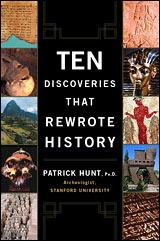
His latest book, "Ten Discoveries that Rewrote History," is due to be released later this month.

"If any global archaeologist were asked to name the top ten archaeological discoveries that have made the greatest impact on archaeology and history, most lists would be likely to unanimously mention the following huge impact discoveries: the Rosetta Stone, Pompeii, Nineveh, Troy, King Tut's Tomb, Machu Picchu, Thera-Akrotiri, the Dead Sea Scrolls, Olduvai Gorge starting with the Leakey Era and the Tomb of the Ten Thousand Warriors in China. This exciting book, written with a taut narrative, relates the dramatic moments of these discoveries, whether by professional archaeologists or by amateurs' accidents, and highlights their significance to history." - Penguin/Plume Publishers.

Contact Information: phunt@stanford.edu

Friday, July 27, 2007

Dr. Anise K. Strong


Anise K. Strong's primary areas of interest are Roman social history, gender and sexuality in the ancient world, and the reception of classical culture, especially in modern mass media. She is currently working on transforming her dissertation entitled, "Labeled Women: Roman Prostitutes and Persistent Stereotypes," into a book. She has published articles on ancient incest laws and sexuality in the HBO series "Rome," and has presented at multiple major conferences, including thrice at the American Philological Association annual meeting. She is an affiliate of the Classical Traditions Initiative.

Since I am passionately interested in the use of technology to facilitate the study of history, I was intrigued by a recent project she conducted within an introductory Roman Civilization course last spring.

"Each of the 115 students in the course edited or created a Roman history "stub" article on Wikipedia, ranging from the province of Gallia Aquitania to the house of Julia Felix in Pompeii. Each article contained references to at least one primary source from the ancient world (including images), one encyclopedic source, and one scholarly book or article. Each student also evaluated and commented on two-three other related student-written articles on their discussion pages.

Here's the link:
http://en.wikipedia.org/wiki/Wikipedia:School_and_university_projects#Northwestern_University_.28Spring_2007.29

It was a wonderfully successful project, although it will be difficult to repeat. Numerous students
- juniors and seniors - told me it was the first time they had ever had to check an actual book out of the library in their college career. Rather than generating a generic, useless paper, they
contributed to the sum of readily accessible human knowledge.


Contact info: Anise-strong@northwestern.edu