Wednesday, August 02, 2006

Garrett G. Fagan


Garrett G. Fagan
Associate Professor (from 1 July 2002) in Classics and Ancient Mediterranean Studies and History
Pennsylvania State University
Ph.D., McMaster University


"Garrett G. Fagan has taught at The Pennsylvania State University since 1996. He was born in Dublin, Ireland, and educated at Trinity College, Dublin. He received his Ph.D. from McMaster University, Hamilton, Ontario, and has held teaching positions at McMaster University, York University (Canada), the University of North Carolina at Chapel Hill, Davidson College, and, The Pennsylvania State University. In all of these institutions, students have given very high ratings to his courses on the classical world. He has also given numerous public lectures to audiences of all ages.

Professor Fagan has an extensive research record in Roman history and has held a prestigious Killam Postdoctoral Fellowship at the University of British Columbia in Vancouver and an Alexander von Humboldt Research Fellowship at the University of Cologne, Germany. He has published numerous articles in international journals, and his first monograph, Bathing in Public in the Roman World, was published by the University of Michigan Press in 1999. He has also edited a volume from Routledge on the phenomenon of pseudoarchaeology (2005). His current research project is on spectatorship at the Roman arena, and he is also working on a book on ancient warfare." - The Teaching Company

PhD DISSERTATION: Three Studies in Roman Public Bathing: Origins, Growth and Social Aspects

RESEARCH INTERESTS: Ancient history (society, politics, and culture); Latin epigraphy

Publications:

Books:

BOOK:

Bathing in Public in the Roman World. Ann Arbor: University of Michigan Press, 1999.

Paperback edition, March 2002.

(with Paul Murgatroyd), From Augustus to Nero: An Intermediate Latin Reader. Cambridge: Cambridge University Press

Successes, Failures and Mediocrities: Ahenobarbi and Pisones in an Age of Transiton. Ann Arbor: University of Michigan Press


PAPERS AND ARTICLES:

Roman Studies

  • "Pliny Naturalis Historia 36.121 and the Number of Balnea in Early Augustan Rome." Classical Philology 88 (1993): 333-35.
  • "Sergius Orata: Inventor of the Hypocaust?" Phoenix 50 (1996): 56-66 [An earlier version was delivered at the APA/AIA Annual Meeting, December 1992.]
  • "The Reliability of Roman Rebuilding Inscriptions." Papers of the British School at Rome 64 (1996): 81-93.
  • "Gifts of Gymnasia: A Test Case for Reading Quasi-Technical Jargon in Latin Inscriptions." Zeitschrift für Papyrologie und Epigraphik 124 (1999): 263-75
  • "Interpreting the Evidence: Did Slaves Bathe at the Baths," in D. E. Johnston and J. DeLaine (edd.), Roman Baths and Bathing (Portsmouth, RI, JRA Supplementary Series 37, 1999), 25-34.
  • "Tiberius;" "Gaius (Caligula);" "Claudius;" "Tiberius Gemellus;" "Drusus Caesar;" "Nero Caesar;" "Britannicus;" "Messalina;" "Drusus Claudius Nero;" "Drusus Tiberi f.;" "Germanicus;" "Agrippinae Maior et Minor." Entries out or forthcoming in De imperatoribus Romanis. An Online Encyclopedia of Roman Emperors (Articles at this site are peer-reviewed.)
  • "Hygenic Conditions in Roman Public Baths," in G. Jansen, ed., Cura Aquarum in Sicilia (Leiden, 2000), page numbers not yet available
  • "The Genesis of the Roman Public Bath: Recent Approaches and Future Directions," American Journal of Archaeology 105 (2001): 403-26.
  • "Messalina's Folly," in Classical Quarterly 52 (2002): forthcoming.
  • "Leisure," in D. Potter (ed.) The Blackwell Companion to the Roman Empire (Oxford: Blackwell, 2002): forthcoming.

Contact information:

108 Weaver Building
University Park
PA 16802-5500
Tel: (814) 863-0091
Fax: (814) 863-7840

email: ggf2@psu.edu

Thursday, May 18, 2006

Matthew B. Roller


Johns Hopkins University: "Matthew Roller is a Romanist who is engaged with the literature, history, art, philosophy, and culture most broadly of the ancient Roman world. He is the author of Constructing Autocracy: Aristocrats and Emperors in Julio-Claudian Rome, which appeared in 2001 from Princeton University Press. This book examines the processes by which aristocrats of the early Imperial period negotiated the nature and scope of the Roman emperor's authority in the context of the emerging autocratic regime.

He is also interested in Roman foodways and in the history of the body. These interests are brought together in a monograph, Dining posture in ancient Rome: bodies, values, and status, appearing from Princeton University Press in Spring 2006. This book investigates the social practices and ideologies associated with the three bodily dispositions-reclining, sitting, and standing-that were available to Romans of different ages, sexes, and social statuses when dining."

See related post in "Academic Presentations On The Roman Empire".

Office: 118 Gilman Hall
Phone: 410-516-5095
E-mail: mroller@jhu.edu

Friday, May 12, 2006

Gregory Aldrete, University of Wisconsin, Green Bay


I noticed an article about Professor Gregory Aldrete of the University of Wisconsin at Green Bay, presenting a program about Roman oratory to a local group. He sounded like a very interesting and motivated scholar so I checked out his webpage:

"After earning my undergraduate degree from Princeton University and my Ph.D in ancient history from the University of Michigan, I joined the History Department at UWGB in 1995. I teach classes in History and Humanistic Studies including: Foundations of Western Culture I, Perspectives on Human Values: The Classical World, History of Ancient Greece, History of Ancient Rome, Topics in Ancient History, and Interdisciplinary Themes and Great Works courses.

My particular areas of research interest are the social and economic history of the Roman Empire, rhetoric and oratory, and urban problems in the ancient world. My major publications include a number of books, among them, Floods of the Tiber in Ancient Rome, (Johns Hopkins 2006), Gestures and Acclamations in Ancient Rome (Johns Hopkins, 1999), Daily Life in the Roman City: Rome, Pompeii and Ostia (Greenwood, 2004), and The Greenwood Encyclopedia of Daily Life in the Ancient World (Greenwood, 2004), as well as various chapters in books and articles. Currently I am writing a college textbook for use in Western Civilization survey classes which is under contract with McGraw Hill. I have been fortunate enough to have held a number of fellowships which have enhanced my understanding of the ancient world and made possible research trips to Italy to view museum collections and archaeological sites. Most pleasant of these were two NEH fellowships which allowed me to spend several summers at the American Academy in Rome. Recently, I was also awarded a full-year NEH Humanities Fellowship for 2004-2005 which enabled me to spend the year finishing my book on floods. In the summer of 2006 I will attend an NEH seminar at UCLA that will investigate using high-tech three-dimensional virtual reality models of ancient Rome as aids to teaching and research.

I firmly believe in an interdisciplinary approach to the study of the ancient world which combines history, philology, archaeology, and art history and which uses both textual and physical evidence. For me, some of the most exciting moments of my research, such as examining 1,500 year old manuscripts at the Vatican Library, have involved physical evidence, and I have tried to incorporate this approach into my teaching as well, by bringing artifacts such as coins into the classroom and by always emphasizing the close reading of a variety of primary sources. As a teacher, my goals are to convey to my students a bit of the enthusiasm for and fascination with the ancient world that I feel, and to show some of the connections between that world and our own."

Contact Info:

Office: 369 Theatre Hall
e-mail: aldreteg@uwgb.edu
phone: (920) 465-2467

Mailing address:
University of Wisconsin-Green Bay
2420 Nicolet Dr., Theatre Hall 331
Green Bay, WI 54311

I think he makes a very formidable looking legionary as well! He has some great pictures of his students undergoing Roman army training too!

Friday, May 05, 2006

Jane Biers Retires from Missouri University


Former Adjunct Professor and Director, Museum of Art and Archaeology
Roman Archaeology, Curator of Ancient Art
Ph.D., University of California, Berkeley

"Archaeology has taken Jane Biers many places in her life; from the forgotten Roman outposts of England, where she witnessed her first excavations, to the sprawl of Athens, where she met her husband, to the fledgling young museum of an American university town, where she carved out her place in the world.

When she stepped down as interim director of MU?s Museum of Art and Archaeology last month, Biers was retiring for the second time from a university career that spanned more than 3½ decades.

It was language that first drew Biers, 67, down the winding career path that would lead her to Columbia ? not the romance of digging up ancient treasures, nor the adventurous crack of a bullwhip. In the late 1950s, she was growing up in Oxford, England, where Latin was a required part of high school-level curriculum.

"It wasn't that I always wanted to be an archaeologist," Biers said. "It's just I sort of progressed from Latin to learning (ancient) Greek to learning ancient history."

She was in the right place at the right time: a town home to one of the oldest and most reputable universities for the study of classical literature, philosophy and history ? or ?Greats.? Biers attended Oxford University for her undergraduate degree. At Oxford, she was granted the opportunity to work at important new dig sites: St. Albans, once home to the Roman city of Verulamium, and Fishbourne, a first-century villa likely inhabited by the local Roman puppet king."


Research

As an archaeologist, Jane Biers? research interests have been focused on Roman Baths. Her most recent publication on the subject can be found in Corinth, the Centenary, 1896-1996, Corinth v. 20. As curator of ancient art at the Museum of Art and Archaeology from 1974-2000, she has, however, been involved in a number of other research projects. Her most recent publications are Testament of Time: Selected Objects from the Collection of Palestinian Antiquities in the Museum of Art and Archaeology, University of Missouri-Columbia (2004), which she edited with James Terry. She was also the editor of A Peaceable Kingdom: Animals in Ancient Art from the Leo Mildenberg Collection, Part VI (2004).


mailing address:
Museum of Art and Archaeology
1 Pickard Hall
Columbia, MO 65211-1420

phone: 573-882-5075
fax: 573-884-4039
email: BiersJ@missouri.edu

Monday, April 17, 2006

Josiah Osgood, Georgetown University


"Josiah Osgood is Assistant Professor of Classics at Georgetown University, where he lectures on Roman history and Latin literature. He undertook his graduate studies at Yale University where his doctoral dissertation was awarded the John Addison Porter prize for outstanding academic writing.

His first book, Caesar's Legacy : Civil War and the Emergence of the Roman Empire, was published in February 2006 by the Cambridge University Press. His research interests are Roman social history, Late Republican culture and the Age of Augustus.

Contact information
Phone
Work: 202-687-7102
Email jo39@georgetown.edu

Friday, February 24, 2006

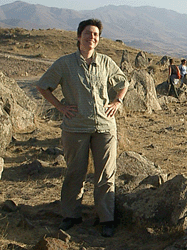
Susan E. Alcock, University of Michigan


John H. D'Arms Collegiate Professor of
Classical Archaeology and Classics

Current research: A project in Armenia.

"Armenia is very interesting for anyone intrigued with the archaeology of memory because it's a country that has a very strong sense of itself through time--Armenians would say it's the first Christian nation, for instance. One tempting thing about our project is that in Armenia there hasn't been that much scholarly attention paid to the Hellenistic, Roman, and Parthian periods--which are what interest me as a classical archaeologist."

"...most of the archaeology done there so far has also been in the Soviet tradition. So techniques that are quite familiar today in the Mediterranean, such as regional survey, are unfamiliar in the Caucasus. On the other hand, the local archaeologists have wonderful knowledge and control of, for example, their ceramic data. So we hope to marry these two traditions, and do something new and very exciting."

Special Interests: Hellenistic and Roman East, landscape archaeology, archaeological survey, archaeology of imperialism

Selected Publications: Graecia Capta: The Landscapes of Roman Greece, Placing the Gods: Sanctuaries and Sacred Space in Ancient Greece (co-editor); The Early Roman Empire in the East (editor); Pausanias: Travel and Memory in Roman Greece (co-editor; forthcoming); Empires (editor, forthcoming)

Contact:
salcock@umich.edu
2172 Angell Hall
(734) 936-3888

Thursday, February 23, 2006

Philip A. Harland, Concordia University


Philip A. Harland is presently Assistant Professor (Social and Cultural History of Christianity) in the Religion Department of Concordia University, Montreal. He received his bachelor?s degree in both History and Religious Studies from the University of Waterloo before pursuing graduate studies at the University of Toronto. His master?s degree and doctorate in Christian origins and the religions of antiquity came from the Centre for the Study of Religion. Before assuming his present position at Concordia, his was teaching at several universities in Ontario, including Wilfrid Laurier University, University of Waterloo, University of Toronto, York University, and McMaster University. His teaching and research focus on the comparative study of Judaism, Christianity, and other religions in ancient society, as well as the social history of the Greco-Roman world generally.

He is currently leading a multi-year seminar within the Canadian Society of Biblical Studies focussed on studying the intersection of religion and travel in antiquity (including pilgrimage, travel to promote the efficacy of a God or gods, ethnography and travel-writing). Furthermore, he is in the midst of preparing a book-length study on the dynamics of identity in the world of the early Christians (especially familial dimensions of group identity). Another of his ongoing projects investigates acculturation and identity among immigrant groups in the Greco-Roman world, shedding light on Judeans in the diaspora. He also has teaching interests in the social and cultural history of Christianity from origins to present generally, as well as the place of women and issues of gender within that history.

Books

2003

Associations, Synagogues, and Congregations: Claiming a Place in Ancient Mediterranean Society. Minneapolis: Fortress Press, 2003.

(Winner of the F. W. Beare Book Award, Canadian Society of Biblical Studies, 2004)

Articles in Refereed Journals
(Click on blue highlighted titles to view online articles)

2006

?Acculturation and Identity in the Diaspora: A Jewish Family and ?Pagan? Guilds at Hierapolis,? Journal of Jewish Studies (forthcoming, accepted for publication).

?Familial Dimensions of Group Identity (II): ?Mothers? and ?Fathers? in Associations and Synagogues of the Greek World,? Journal for the Study of Judaism (forthcoming, accepted for publication).

2005

?Familial Dimensions of Group Identity: ?Brothers? (???????) in Associations of the Greek East,? Journal of Biblical Literature 124 (2005) 491-513.

2003

?Christ-bearers and Fellow-initiates: Local Cultural Life and Christian Identity in Ignatius? Letters,? Journal of Early Christian Studies 11 (2003) 481-99.

?Imperial Cults within Local Cultural Life: Associations in Roman Asia,? Ancient History Bulletin / Zeitschrift für Alte Geschichte 17 (2003) 85-107.

2000

?Honouring the Emperor or Assailing the Beast: Participation in Civic Life among Associations (Jewish, Christian and Other) in Asia Minor and the Apocalypse of John,? Journal for the Study of the New Testament 77 (2000) 99-121.

1996

?Honours and Worship: Emperors, Imperial Cults and Associations at Ephesus (first to third centuries c.e.),? Studies in Religion/Sciences religieuses 25 (1996) 319-34.

Articles in Books and Reference Works

2006

The Declining Polis? Religious Rivalries in Ancient Civic Context,? in Religious Rivalries and Relations Among Pagans, Jews, and Christians, edited by Leif E. Vaage. Waterloo: Wilfrid Laurier University Press (forthcoming).

?Associations and the City,? in Associations in the Ancient World: Cults, Guilds and Collegia, co-authored with John S. Kloppenborg and Richard Ascough. Berlin: de Gruyter (forthcoming).

2005

?Spheres of Contention, Claims of Preeminence: Rivalries Among Associations in Sardis and Smyrna,? in Religious Rivalries and the Struggle for Success in Sardis and Smyrna, edited by Richard Ascough, pp. 53-63. Waterloo: Wilfrid Laurier University Press, 2005.

2002

?Connections with Elites in the World of the Early Christians,? in Handbook of Early Christianity: Social Science Approaches, edited by Anthony J. Blasi, Paul-André Turcotte, and Jean Duhaime, pp. 385-408. Walnut Creek, CA: Alta Mira Press, 2002.

?The Economy of First Century Palestine: The State of Scholarly Discussion,? in Handbook of Early Christianity: Social Science Approaches, edited by Anthony J. Blasi, Paul-André Turcotte, and Jean Duhaime, pp. 511-27. Walnut Creek, CA: Alta Mira Press, 2002.

2000

?Bithynia,? ?Mysia,? ?Pamphylia,? and ?Perga,? in Eerdmans Dictionary of the Bible, edited by D.N. Freedman, A.B. Beck and A.C. Myers. Grand Rapids: Eerdman, 2000."

Contact: pharland@alcor.concordia.ca


Thursday, February 16, 2006

Dr Philip de Souza


UCD - School of Classics: "BA, MA, PhD (Lond.), FRHistS

College Lecturer
E-mail: philip.desouza@ucd.ie
Tel. 353 1 716 8170
Room K206, John Henry Newman Building

Research Interests
Greek and Roman social and economic history, esp. warfare and piracy.

Recent Publications

* The Greek and Persian Wars 499-387 BC (Osprey, January 2003).
* The Peloponnesian War 431-404 BC (Osprey, November 2002).
* Seafaring and Civilisation: Maritime Perspectives on World History (London: Profile 2001; paperback edition June 2002). German edition: Seefahrt und Zivilisation (Hamburg: marebuchverlag 2003).
* Piracy in the Graeco-Roman World (Cambridge University Press 1999: paperback edition April 2002).
* Beyond the Horizon: locating the enemy in ancient naval warfare. In: J. Andreau & C. Virlouvet (eds.), Mer et circulation de l?information dans le monde antique (?cole Fran?aise de Rome, 2002).
* Western Mediterranean Ports in the Roman Empire: First Century BC to Sixth Century A.D. The Journal of Mediterranean Studies 10 (2001) 229-254.
* Articles on: ?Mycenaean and Homeric Warfare 1600-600 BC?, ?The Persian Wars 490-448 BC?, ?The Peloponnesian Wars 480-404 BC? and ?Hellenistic and Macedonian Warfare 400-200?, ?Ancient and Classical Warfare?. In: The Reader?s Guide to Military History, ed. C. Messenger (London: Fitzroy Dearborn, 2001).
* Ancient Rome and the Pirates. History Today (July 2001) 24-31."

Alexander Thein, University College Dublin

Alexander Thein: "Contacts

E-mail: alexander.thein@ucd.ie

Tel. 353 1 716 8662

Room K204, Arts Building
Research interests

Roman Archaeology, esp. the topography of the city of Rome; Roman Republican History, esp. the Sullan Dictatorship.
Recent Publications

Ad Pictas and the Junction of the Via Latina and Via Labicana. In: Papers of the British School at Rome 73 (2005, forthcoming).

Sulla the ?Weak? Tyrant. In: Sian Lewis (ed.), Tyrants and Autocrats in the Classical World (Edinburgh: Edinburgh University Press, forthcoming).

Sullan veteran settlements. In: Papers of the British School at Rome 72 (2004) 363-4.

Review of Francis Cairns and Elaine Fantham (eds.), Caesar against Liberty? Perspectives on his Autocracy, Papers of the Langford Latin Seminar 11 (Cambridge: Francis Cairns [Publications], 2003). In: Journal of Roman Studies 94 (2004) 239.

Review of Karl Christ, Sulla. Eine r?mische Karriere (Munich: C. H. Beck, 2002). In: Bryn Mawr Classical Review 2003.03.08 (http://ccat.sas.upenn.edu/bmcr/2003/2003-03-08.html)

David Woods, University College, CORK (National University of Ireland)

David Woods, Ancient Classics, UCC: "David Woods graduated with a 1st class BA in Greek and Latin from St. Patrick's College, Maynooth, in 1987. He did his postgraduate research at the Queen's University of Belfast under the supervision of Dr. Raymond Davis. He obtained his PhD in 1991 for his thesis ?The Christianization of the Roman Army in the Fourth Century.?

He then worked in the Rescue and Insolvency Division of the chartered accountants Coopers & Lybrand, Belfast. He taught Latin for a year (1995-96) at St. Patrick's Classical School, Navan, Co. Meath, before obtaining a temporary appointment in the Department of Ancient Classics, St. Patrick's College, Maynooth (1996-98). He is now College Lecturer at the Department of Ancient Classics at UCC, teaching language courses and Roman history.

Research Interests

* The Reigns of Caligula and Nero
* The Reign of Constantine I
* The Latin Historian Ammianus Marcellinus (c. AD390)
* The Military Martyrs
* Early Hiberno-Latin Texts
* The Byzantine Chronicler Theophanes (c. AD814)
* The Arab-Byzantine Conflict in the 7th Century"

Recent publications:
  1. ?The Constantinian Origin of Justina (Themistius, Or.3.43b)?
    Classical Quarterly 54 (2004), 325-27
  2. ?Amm. 21.6.3: A Misunderstood Omen?
    Classical Philology 99 (2004), 163-68
  3. ?The Crosses on the Glass Pilgrim Vessels from Jerusalem?
    Journal of Glass Studies 46 (2004), 191-95
  4. ?Some Dubious Stylites on Early Byzantine Glassware?
    Journal of Glass Studies 46 (2004), 39-49
  5. ?Acorns, the Plague, and the 'Iona Chronicle'?
    Peritia 17-18 (2003-04), 495-502
  6. ?Nero's Pet Hippopotamus (Suet. Nero 37.2)?
    Arctos 38 (2004), 219-22
  7. ?Malalas, "Constantius", and a Church-Inscription from Antioch?
    Vigiliae Christianae 59 (2005), 54-62
  8. ?The Consequences of Nero's Ill-Health in AD64?
    Eranos 102 (2004), 109-16
  9. ?Sopater of Apamea: A Convert at the Court of Constantine I ??
    Studia Patristica forthcoming
    1,900 words
  10. ?The Origin of the Cult of St. George?
    in forthcoming conference proceedings
    7,600 words
  11. ?The Good Soldier's End: From Suicide to Martyrdom?
    in forthcoming conference-proceedings
    5,800 words
  12. ?Adomnán, Arculf, and Aldfrith?
    in forthcoming conference-proceedings
    8,100 words
  13. ?Tacitus, Nero, and the 'Pirate' Anicetus?
    Latomus, forthcoming
    3,400 words
  14. ?Jews, Rats,and the Reason for the Byzantine Defeat at the Battle of Yarmuk?
    in forthcoming conference-proceedings
    6,700 words
  15. ?Adomnán, Arculf, and the True Cross?
    ARAM Periodical, forthcoming
    4,800 words
  16. ?The Cross in the Public Square: The Column-Mounted Cross c.AD450-750?
    in forthcoming conference-proceedings
    5,500 words
  17. ?Libanius, Bemarchius, and the Mausoleum of Constantine I?
    in C. Deroux (ed.), Studies in Latin Literature and Roman History XIII, forthcoming
    4,600 words
  18. ?Caligula, Ptolemy of Mauretania, and the Danger of Long Hair?
    Arctos, forthcoming
    2,400 words
  19. ?An Earthquake in Britain in 664?
    Peritia, forthcoming
    2,000 words
  20. ?Valentinian I, Severa, Marina, and Justina?
    Classica et Mediaevalia 57 (2006), forthcoming
    4,450 words
  21. ?On the Alleged Reburial of Julian the Apostate at Constantinople?
    Byzantion, forthcoming
    2,400 words
  22. ?Flavius Felix and the Signum of the Numerus Divitiensium?
    ZPE, forthcoming
    1,006 words


Current research: Currently preparing papers on various aspects of the reigns of Caligula and Nero, focussing on the origin of some of the more fantastic tales told about these emperors.

Special website project: Military Martyrs

Contact:

Phone: (+ 353 21) 490 3491
Email: d.woods@ucc.ie

Wednesday, February 08, 2006

Olivia Robinson

Olivia Robinson, University of Glasgow, School of Law

Research interest: Roman Law generally, with a particular interest in Roman criminal law.

Recent Publications: Critical Studies in Ancient Law, Comparative Law and Legal History (2001); The Criminal Law of Ancient Rome (2001)

"Early Roman criminal law is both obscure and hotly debated. We only begin to approach reasonable probabilities around 200 BC, the period from which contemporary evidence - Plautus, Cato, and others - survives. Criminal procedures of the period comprised the domestic jurisdiction of the paterfamilias, private criminal actions, the exercise of their powers by the resviri capitales (minor magistrates with police functions), and the jurisdiction of the assemblies of the people, i.e. trials before one of the comitia. In the year 207 BC the Senate ordered a special commission, a quaestio, to investigate the conduct of certain Italian allies arising from the Second Punic War, and such commissions were relatively common in the second century, supplementing the comitial jurisdiction. However, when in 171 BC the provincials of Spain asked the Senate for redress against their governors, the Senate ordered the praetor to whom the Spains had been allotted to appoint recuperatores from among the Senate, but this was a procedure of the private law without a penal element. Then in 149 BC the lex Calpurnia was passed, concerned not only with reparation but also punishment; it established a permanent court of senators as sworn jurors to deal with claims of provincial extortion."

Contact Information:
University of Glasgow, School of Law
5-9 Stair Building, The Square
Glasgow, Scotland, G12 8QQ, United Kingdom
TEL: 0141 330 4507, FAX: 0141 330 4900

o.robinson@law.gla.ac.uk

Thursday, January 19, 2006

Dr. John Patterson


"John Patterson, Lecturer on Ancient History at the University of Cambridge, is a Roman historian who works extensively with the archaeology and material culture of Roman Italy. He is a well-known specialist in the history of the city of Rome (from brick stamps to civic rituals, from amphitheatres to the political arena) ? as well as an expert in the countryside of Roman Italy and its social and economic changes over the imperial period. He has reviewed recent work on both topics in survey articles for the Journal of Roman Studies."

His recent book Political Life in the City of Rome is published by Bristol Classical Press and he is currently working on a city-country relations in Italy in the imperial period.
Dr. Patterson is also studying th epigraphy of the Tiber River Valley as a participant in the Tiber Valley Project.

"Launched in 1997, the Tiber Valley Project involves scholars from twelve British Universities as well as a large number of Italian scholars. The study area centres on the stretch of the middle Tiber between Rome and the Umbrian border town of Otricoli.

This is one of the most intensively studied areas in the whole Mediterranean. Nevertheless, studies so far have tended to concentrate on one or the other side of the river, and no one study has ever attempted to study the valley as a historical entity through time. The aim therefore is to examine the middle Tiber Valley as the hinterland of Rome, looking at the impact of Rome's development on the settlement history, economy and culture of the river valley over two millennia, from 1000 BC to AD 1000.

Over the last five years, a team of researchers at the BSR have been collecting, integrating and reanalysing this data to relate the historical development of Rome to the changes in the settlement, economy and society of the valley from the Bronze Age to the Medieval period. Particular focus has fallen on: (1) the integration of diverse valley communities (Etruscans and Faliscans on the west bank; Sabines and Latins on the east bank) under Rome's progressive expansion as a regional power and then imperial power and (2) the political, social and economic fragmentation which followed the collapse of the Roman Empire in the late antique and early medieval periods when the valley was the centre of a complex interplay of power between Roman-Byzantines, Lombards, Carolingians and the increasingly powerful Papacy and Church."


e-mail: jrp11@cam.ac.uk

Friday, December 23, 2005

Professor Greg Woolf

Professor Greg Woolf:

email: gdw2@st-andrews.ac.uk
phone 01334 462608

A graduate of Oxford and Cambridge, Professor Woolf returned to Oxford in 1990 to teach ancient history and archaeology as a fellow of first Magdalen and then Brasenose Colleges before being elected in 1998 to a chair of ancient history at St. Andrews where he is currently Head of the School of Classics.

I am a member of the Advisory Board of the American Journal of Archaeology.

I have served on the Councils of the Roman Society and the Classical Association and currently sit on the Editorial Boards of both societies. I am a member of the Advisory committees of the Roman Society and of the LTSN subject centre in Classics and have served as an AHRB panellist. I am a member of the American Philological Association, of the Classical Association of Scotland and a Fellow of the Society of Antiquaries of Scotland. I have been an external examiner for undergraduate degrees at Strawberry Hill (Classics), UCL (History), the Open University (Classics), Bristol (Classics) and Sheffield (Archaeology); for taught postgraduate degrees in London; and for doctorates in the Universities of Cambridge, Durham, London, Oxford, Reading, Southampton and Wales. I have contributed to the Cambridge Ancient History and the APA (Barrington) Classical Atlas, and the Neue Pauly. During 2004 I was an Honorary Research Fellow of the British School at Rome.

Research Interests

The cultural history of the Roman empire. My past work has included studies of patronage, of epigraphy as a cultural phenomenon, of literacy and of the economic history of the empire and its urbanization. A major focus of my research has been on the archaeology and history of Roman Gaul, especially the cultural changes usually termed Romanization. I have carried out fieldwork in northern France. I maintain interests in the later prehistory of Europe, in archaeological theory, and in the Younger Pliny. More recently I have been engaged in the study of religious practice in the Roman provinces."

Recent Publications

Regional Productions in early Roman Gaul, in D. Mattingly and J. Salmon (eds.) Economies beyond Agriculture in the classical world (London, 2000), 49-65

The Roman Cultural Revolution in Gaul, in S. Keay and N. Terrenato eds. Italy and the West. Comparative Issues in Romanization, (Oxford, 2001), 173-86.

Inventing empire in ancient Rome, in Empires. Perspectives from archaeology and history edited by S.E.Alcock, T.N.DÕAltroy, K. D. Morrisson and C. M. Sinopoli, Cambridge University Press, Cambridge 2001, 311-22

Representation as Cult: the case of the Jupiter columns, in Spickermann, W., Cancik, H. and Rüpke, J. (eds.), Religion in den germanischen Provinzen Roms, Tübingen 2001, 117-34.

Generations of Aristocracy. Continuities and discontinuities in the societies of Interior Gaul. Archaeological Dialogues 9.1 (2002) 2-15 with discussion 39-65

Afterword: How the Latin West was won, in A.Cooley (ed.) Writing Latin, Becoming Roman, JRA supplementary volume 48 (2002) 181-88

Rome the Cosmopolis Cambridge University Press, Cambridge (2003) edited with Catharine Edwards

Seeing Apollo in Roman Gaul and Germany, in S.Scott and J.Webster (eds.) Roman Imperialism and Provincial Art (Cambridge 2003) 139-152

Cambridge Illustrated History of the RomanWorld (consultant editor, and contributor of three chapters) Cambridge University Press, Cambridge (2003)

A Sea of faith? Mediterranean Historical Review 18.2 (2004) special issue on ?Mediterranean Paradigms and Classical Antiquity? ed. I. Malkin, 126-143

Local Cult in Imperial Context: the Matronae revisited, in P.Noelke ed. Romanisation und Resistenz in Plastik, Architektur und Inschriften der Provinzen des Imperium Romanum. Neue Funde und Forschungen, Akten des VII. Internationalen Colloquiums über Probleme des Provinzialrömischen Kunstschaffens, Köln 2-6 mai 2001, (2004)131-8

"The present state and future scope of Roman Archaeology: a comment" American Journal of Archaeology 108.3 (2004) 417-28

Current Research Projects

At present, Professor Woolf is writing a cultural history of Roman imperialism and a study of the assassination of Julius Caesar and its implications. He is also preparing the 2005 Rhind lectures on Religious Creativity in the Roman Provinces and, together with Dr. Jason Koenig and Prof. Harry Hine, am developing a project on Science and Empire in the Roman World in the context of the Logos Research Centre.

Tuesday, December 13, 2005

Dr. Penelope Allison, Australian National University

Email: Pim.Allison@anu.edu.au

Research interests:

Roman and Australia historical archaeology: Roman painting, household archaeology, gender and space.

Research areas:

Roman Italy, particularly Pompeii; western Roman provinces; western NSW, Australia.

Past and recent research:

1. The wall paintings of the Casa della Caccia Antica in Pompeii - painter workshops, typology and iconography.
2. Pompeian Households - the use of space in Pompeian houses; the abandonment processes of the city. The compilation of relational databases to investigate for the distribution of household activities.
3. The Insula del Menandro in Pompeii: The Finds - artefact distribution and artefact function in the buildings in this city block in Pompeii.
4. The Kinchega Archaeological Research Project - living conditions at a 19th- and early 20th-century pastoral homestead in western NSW, with particular attention to household production and consumption patterns.
5. Engendering Roman Spaces - feminist approaches to Roman spatial archaeology, especially domestic space, military space and public space.

Recent and Main Publications:

2002. Main author with Frank Sear, The Casa della Caccia Antica, H?user in Pompeji 11. (Munich: Hirmer).

2002. Recurring tremors: the continuing impact of the AD 79 eruption of Mt Vesuvius, in R. Torrence and J. Grattan, eds, Natural Disasters and Cultural Change, 107-125 (One World Archaeology series, Routledge, London and New York).

2002. Colour and light in a Pompeian house: modern impressions or ancient perceptions, in A. Jones and Gavin MacGregor, eds, Colouring the Past: The Significance of Colour in Archaeological Research, 195-207 (Berg, Oxford and New York).

2003. Pompeii households: Analysis of the material culture, Monograph 42 (Cotsen Institute of Archaeology, UCLA - to appear in 2003).

Pompeii households: Analysis of the material culture, Database associated with Monograph 42 of Cotsen Institute of Archaeology, UCLA, (http://www.stoa.org/pompeianhouseholds)

2001 P. M. Allison. Using the material and the written sources: turn of the millennium approaches to Roman domestic space, Journal of Archaeology 105: 181-208.

2001 P. M. Allison. Placing individuals: Pompeian epigraphy in context, Journal of Mediterranean Archaeology 14.1: 54-75.

"

Thursday, December 08, 2005

Dr. Zahra Newby, University of Warwick

Email: z.l.newby@warwick.ac.uk

Research:

Dr Newby works on the visual arts of the ancient world. Her doctoral thesis (at the Courtauld Institute of Art, London) studied the elite art of the middle Roman empire in its social and cultural contexts, with a particular focus on the use of art for self-representation. She is also interested in the links between art and text, and the receptions of visual images in the Greek literature of the Roman empire. Her recent research focuses on the reception of Greek athletics in the Roman empire and the representation of Greek mythology in Roman art.

Recent Publications

* Greek Athletics in the Roman World. Victory and Virtue (Oxford University Press, 2005)
* 'Reading Programs in Graeco-Roman Art: reflections on the Spada reliefs' in The Roman Gaze. Vision, Power and the Body, ed. D. Fredrick (Baltimore, 2002), 110-48
* 'Greek athletics as Roman spectacle: the mosaics from Ostia and Rome', Papers of the British School at Rome(2002).
* 'Art and Identity in Asia Minor' in Provincial Art and Roman Imperialismeds S. Scott & J. Webster (Cambridge University Press, 2003), 192-213.
* 'Sculptural Display in the so-called Palaestra of Hadrian's Villa at Tivoli' , Römische Mitteilungen 109 (2002), 59-82.
* ?Testing the boundaries of ekphrasis: Lucian On the Hall?, Ramus 31 (2002) 126?35

Forthcoming Publications

* 'Absorption and erudition in Philostratus' Imagines' in Philostratus eds., E. Bowie & J. Elsner with R. Leader-Newby (eds.) Art and Inscriptions in the Ancient World (Cambridge University Press, 2006),
* Athletics in the Ancient World (Duckworth, 2006)

Dr Alison Cooley, University of Warwick

Email: a.cooley@warwick.ac.uk

"Dr Cooley is interested in all aspects of the Roman world - social, cultural, economic, and political. Her research focuses upon Roman Italy in particular, and upon the use of inscriptions in both ancient and modern times. Recent books include a study of the spread of Latin in the inscriptions of the Roman West and an archaeological history of Pompeii. She contributes a regular series of short articles on Pompeii to the magazine Omnibus. She is currently working on two major projects, a new edition of the Res Gestae and the Cambridge Handbook to Latin Epigraphy (both Cambridge University Press). In 2004 she was awarded The Butterworth Memorial Teaching Award by the University."

Recent Publications:

Forthcoming Publications

  • Entry on ?Inscriptions? (jointly with G.J. Oliver) in The Edinburgh Companion to Ancient Greece and Rome, edd. E. Bispham, T. Harrison, B. Sparkes
  • ?Beyond Rome and Latium: Roman religion in the age of Augustus?, in C. Schultz & P. B. Harvey, eds Numen Adsit (CUP: Yale Classical Studies)

Friday, November 18, 2005

Professor Helen King

Professor of the History of Classical Medicine at Reading University. Her first degree, at UCL, was in Ancient History and Social Anthropology; She then held research fellowships in Cambridge and Newcastle, taught in Liverpool for 8 years, and came to Reading on a Wellcome Trust University Award in 1996. She has been a Fellow at the Netherlands Institute for Advanced Studies (2001), a Landsdowne Visiting Lecturer at the University of Victoria, British Columbia (2002), and a Visiting Professor at the University of Texas at Austin (2005). She is chair of the Wellcome grants panel, 'Research Resources in the History of Medicine'.

Her main interests are:

Ancient medicine. From my PhD (on ancient Greek menstruation) onwards, I have been interested in setting ancient medical thought within its social and cultural context, as one way - among others - of making sense of life. I've therefore looked at ancient ideas about creation, the role of women, and sacrifice to illuminate Hippocratic gynaecology (Hippocrates' Woman: Reading the female body in ancient Greece, Routledge, 1998). From teaching the history of medicine at Reading, I wrote a short introduction to the main issues, Greek and Roman Medicine (Bristol Classical Press, 2001). A volume of essays on Health in Antiquity was published under my editorship in March 2005 (Routledge). Every other year I organise a conference on Ancient Medicine at Reading (in the alternate years, this is run by Professor Philip van der Eijk at Newcastle). I also examine the History of Medicine Diploma run by the Society of Apothecaries, London, and sit on various committees of the Wellcome Trust.


Reception of ancient medicine. I have written on the use of classical models in nursing and midwifery, but I am particularly interested in the alleged (and imaginary) classical origins of 'hysteria', on which I've published Hysteria Beyond Freud (written with S. Gilman, R. Porter, G.S. Rousseau and E. Showalter, University of California Press, 1993), a section in History of Clinical Psychiatry (eds G. Berrios and R. Porter, Athlone Press, 1995), and 'Recovering hysteria from history: Herodotus and "the first case of shell shock"' in Peter Halligan et al. (eds), Contemporary Approaches to the Science of Hysteria: Clinical and Theoretical Perspectives (Oxford University Press, 2001). My project for the first five years at Reading, on which I continue to work, concerned the reception of the sixteenth-century compilation, the Gynaeciorum libri, edited successively by Wolf, Bauhin and Spach; in particular, the impact of Hippocratic gynaecology in the period after its publication in Latin by Calvi in 1525, but also the subsequent history of the books themselves, their owners and their uses. I have given a number of sections of this project as papers, and incorporated some of my findings into my monograph The Disease of Virgins: Green-Sickness, Chlorosis and the Problems of Puberty (Routledge, December 2003), which moves from sixteenth-century ideas based on Hippocratic medicine, to the early twentieth century. On the Modern History MA, I teach a module called 'Viewing the body in seventeenth-century England', which uses Harvey's De motu cordis as a way of discussing issues of authority and science. Harvey's discovery of the circulation of the blood explicitly cites Aristotle on the circle as the purest form of movement. From 1998-2003 I was the co-editor of Social History of Medicine (Oxford University Press).


Gender/History of the body. I have published on the history of pain, drawing on comparative studies of modern sufferers from chronic pain. I have published on early sexology and I am currently working on myths and stories of bearded women. I was Women's Studies Area Advisor to the Oxford Classical Dictionary (1996).


Mythology. I have published on the myths of Tithonos, on mermaids (on which topic I have also done a lot of media work), and on the myth/fable of Agnodike, 'the first midwife'; I've also investigated how this story was used to give authority to women in medical roles in various historical periods. I'm preparing an article, 'Mothering medicine', on the wider dimensions of this topic.


Death. In 1981 I co-edited, with S.C. Humphreys, Mortality and Immortality: the anthropology and archaeology of death (Academic Press). I've recently been working on the role of the doctor at the deathbed in classical antiquity; a preliminary study has been published in Dutch."

Contact: h.king@reading.ac.uk

Dr. Ken Dark

"After taking his PhD at the University of Cambridge, Ken Dark has taught at Cambridge, Oxford and Reading Universities, and currently holds a lectureship at the University of Reading. He is Chair of the Late Antiquity Research Group, holds honorary professorships from European and American universities, and is the author of numerous publications, including Britain and the End of the Roman Empire, Civitas to Kingdom, Theoretical Archaeology and The Landscape of Roman Britain. He has directed archaeological excavations and surveys in Britain, and is currently director of the Istanbul Archaeological Rescue Project.

Chair of GCMS, Director of the Research Centre for Late Antique and Byzantine Studies

Main Area of Work: Archaeology (Roman, Dark Age, Celtic, Byzantine, Theory);History (Roman, Dark Age, Celtic, Byzantine, Theory); Byzantine studies (including Istanbul. Constantinople);
Global political and economic change

Director of the Research Centre for Late Antique and Byzantine Studies;

Research Interests:

Archaeology (Roman, Dark Age, Celtic, Byzantine, Theory);
History (Roman, Dark Age, Celtic, Byzantine, Theory);
Byzantine studies (including Istanbul. Constantinople);
Global political and economic change

The archaeology and history of Europe (including Britain) and the Middle East in the 1st millennium AD (including Roman, Late Antique, Byzantine and Viking Age studies).

Archaeological and historical method and theory.
Field archaeology (excavation, geophysical and surface survey) and artefact studies (esp. ceramics and sculpture).
The study of large-scale, long-term, social, political and economic change (especially the formation and collapse of states and regional political and economic systems).

Other Expertise
Detailed knowledge of theory and academic debate in cognate discplines (especially political science, economics, anthropology and social theory)

Detailed knowledge of Complexity Theory and its application to human societies.

Contact: k.r.dark@reading.ac.uk

Dr. John Creighton

"Dr. John Creighton?s research centres upon Later Iron Age and Early Roman NW Europe. His books include: ?Britannia: the creation of a Roman Province? (2005); ?Coins & Power in Late Iron Age Britain? (2000), 'Celti: the archaeology of a Hispano-Roman Town in Baetica' (with Simon Keay and Jose Remesal, 2001), and he has co-edited the volume 'Roman Germany: Studies in Cultural Interaction' (1999).
His fieldwork has included work in Britain, France, Germany and Spain. Presently he is completing a project, with Colin Haselgrove, examining the landscape in the vicinity of the Iron Age oppidum of Mont Beuvray (Bibract) and the Roman town of Autun in Burgundy.
He is currently the Director of CETL-AURS, an interdisciplinary centre for promoting and developing undergraduate research skills across the University.

Research Interests:

* Imagery and the negotiation of power
* Coinage and commodification
* Urban landscapes and social memory"

Recent Publications:

Creighton, J. (2005) Gold, ritual and kingship In Iron Age Coinage and Ritual Practices (Eds. Wigg-Wolf, D. and Haselgrove, C. C.) Verlag Philipp von Zabern, Mainz am Rhein, pp. 69-84.

Contact: lascretn@reading.ac.uk

W. Ralph Johnson

University of Chicago Department of Classics: "W. Ralph Johnson

John Matthews Manly Distinguished Service Professor of Classics and Comparative Studies, Emeritus,
University of Chicago
l050 E 59th St, Chicago IL 60637

Education

B.A. Latin, 1961, UC, Berkeley
M.M. Latin, 1963, UCB
Ph.D. Classics, 1967, UCB

Positions

Assistant Prof. Classics, UC Berkeley, 1966-72
Associate Prof. Classics and Comp. Lit, UCB, 1972-4
Associate Prof. and Prof. Classics, Cornell University, 1974-81
Professor of Classics and Comp. Lit., University of Chicago,
l981-98 (Manly Prof. since 1989)
Emeritus, 1998

Awards & Honors

Distinguished Teaching Award, UC Berkeley 1971
Board of Directors, American Philological Association, 1981-84
Chair of Classics, UChicago, 1983-88
Christian Gauss Award for Literary Criticism, Phi Beta Kappa, 1983
The Martin Lectures in Classics at Oberlin, 1984-5
The Townsend Lectures in Classics at Cornell, 1988-89
Committee on Goodwin Award, APA, 1989-91
Committee on American Journal of Philology Award, 1997-2000
Visiting Prof., University of Michigan, Ann Arbor, Winter 2001
Visiting Prof. UCLA, Spring 2002
Scheduled for Spring 2004, The Biggs Lectures (on Propertius and Augustan Poetry), Washington University, St. Louis

Books

Luxuriance and Economy: Cicero and the Alien Style (University of California Press, 1971)

Darkness Visible: A Study of Vergil's Aeneid (UC Press, l976)

The Idea of Lyric (UC Press, l982);

Momentary Monsters: Lucan and his Heroes (Cornell, l987)

Horace and the Dialectics of Freedom (Cornell, 1993)

Lucretius and the Modern World (Duckworth 2000)

Recent Articles

Imaginary Romans: Virgil and the Illusions of National Identity,' in Poets and Critics Read Virgil, ed. S. Spence, Yale (2001)

'A Secret Garden in Georgics 4,' in Vergil, Philodemus and the Augustans, ed. Skinner and Johnston, U Texas Press (2003)

'Robert Lowell's American Aeneas,' in Festschrift for M. Putnam, ed.S. Spence, Materiali e discussioni (2004)

'Small Wonders: Martial, Book 14,' Festschrift for W. S. Anderson, ed. W. Batstone and G. Tissol, 2004